


For patients in their 40s and 50s, the decision to undergo a facelift often requires much more careful contemplation than one might expect.
This makes sense, as a facelift is widely perceived as a major, life-altering procedure. I completely understand how daunting it can be to navigate the process step-by-step—wondering about the effectiveness of the results, the actual recovery time, and the overall cost.
Today, I want to have a completely candid conversation and directly address the real questions you have about getting a facelift in middle age.
How Much Does a Facelift Actually Cost?
Let’s talk about the cost first.
Facelift prices vary significantly from clinic to clinic. Even if two clinics use the exact same term, “facelift,” one place might start in the 5 million KRW (approx. $3,700 USD) range, while another might charge upwards of 20 million KRW (approx. $15,000 USD).
Why is there such a massive price difference?
The primary reason lies in the surgical method. The cost fluctuates depending on whether you are getting a mini-facelift with a relatively limited incision, our signature Plus-Up Lifting which extends behind the ear, or a full facelift that comprehensively addresses the neck.
Furthermore, the depth of the tissue dissection, the duration of the surgery, and the quality of the threads and materials used all heavily impact the final price. Naturally, if you combine the facelift with other procedures, the cost difference will widen.
Generally speaking, a comprehensive facelift for middle-aged patients in Korea typically ranges from just under 10 million KRW to the low 20 million KRW range.
Of course, every clinic has different standards, and the exact price depends entirely on your unique condition. In all honesty, it is nearly impossible to provide a perfectly accurate quote through a blog post. This is because every patient has a different surgical history and requires a different scope of surgery. One patient might achieve excellent results with just the Plus-Up Lifting, while another might absolutely need a full facelift that includes the neck. Inevitably, their costs will differ.
However, I want to emphasize one crucial point: Whether a clinic’s price is exceptionally low or unusually high, you need to understand the reasoning behind that price.
For example, if a surgery costs around 5 million KRW, it is highly likely a limited mini-facelift. With a restricted incision range, it is often very difficult to sufficiently address the deeper sagging that naturally occurs in middle-aged patients.
At our clinic, we strictly perform only one facelift surgery per day. We also operate a dedicated, professional therapist team alongside an executive director from the ISO International Medical Beauty Safety Association to focus entirely on personalized 1:1 patient care. Because we invest so heavily in this individualized attention, our costs are not on the lowest end of the spectrum.
Real Transformations: Results for Patients in Their 50s
Judging whether a cost is truly “reasonable” ultimately comes down to the results. The most important factors are how natural the transformation looks and the actual extent of the lifting effect.
Let me explain the recovery timeline based on the real before-and-after progress of middle-aged patients who have undergone surgery at our clinic.
Month 1: Returning to Daily Life
By the one-month mark, most patients have seamlessly returned to their normal daily routines. Any lingering, minor bruising can be easily covered with light makeup. When you look in the mirror, you will clearly see that your jawline and cheek contours have been beautifully refined. This is usually the time when people around you start asking, “Are you getting skin treatments lately?” or “Did you lose weight?”
Week 1: The Initial Healing
By the first week, the most significant initial swelling has largely subsided. While close friends and family might notice you had a procedure, strangers on the street usually won’t be able to tell. From this point on, you will start to physically feel the changes and think, “It’s gradually getting better day by day.”
Month 3: The Final, Settled Result
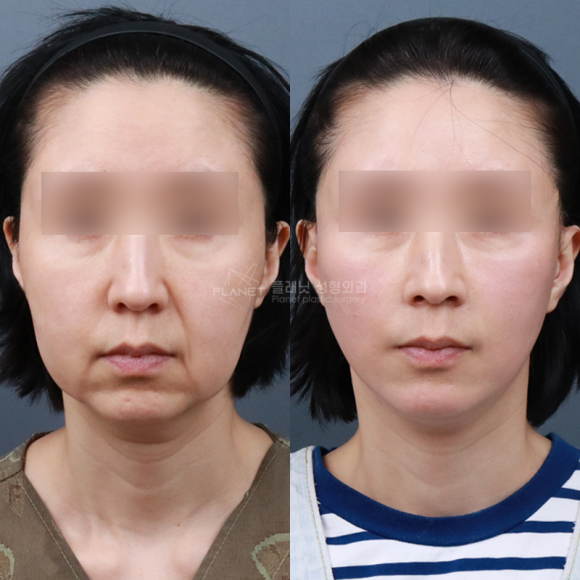
By the third month, the vast majority of residual swelling has resolved, and you are looking at about 90% of your final, permanent result. This is the period when patient satisfaction peaks. A highly natural, definitively younger-looking impression has fully settled in.
In reality, the area our patients are consistently most thrilled with is the jawline. I frequently hear them say, “I am so happy that I can actually see my jawline every time I look in the mirror now.” Furthermore, as deep nasolabial folds (smile lines) and marionette lines are smoothed out, the patient’s overall expression becomes much softer and more elegant.
A Word on Realistic Expectations
I never want to give my patients false promises. A facelift will not turn back the clock to your 20s. However, turning back the clock to make you look about 10 years younger? That is entirely possible.
Above all, a natural-looking change is our ultimate goal. To ensure this, we provide highly systematic care for approximately 3 months through our proprietary “Golden Plan” Aftercare Program. We offer customized treatments tailored perfectly to each stage of your recovery on days 1, 3, 7, and 10, followed by thorough check-ups at the 1, 2, and 3-month marks.
Because the surgeon who directly performed your operation oversees your entire recovery process, we understand your facial anatomy better than anyone else. We know exactly which areas were dissected, how deeply they were lifted, and which spots are prone to swelling, allowing us to provide incredibly precise, meticulous care.
Final Thoughts on Choosing Your Surgeon
If you are considering a facelift in your 50s, the cost is undoubtedly an important factor.
But what matters far more than the price tag is the result. A cheap surgery doesn’t make it a smart choice, and an expensive surgery doesn’t automatically make it the best one.
The absolute wisest decision you can make is to find a highly qualified clinic that accurately assesses your unique condition and meticulously performs the exact surgical method you need.
FAQ
A. The price variation primarily comes down to the surgical method and the scope of the procedure. A procedure priced around 5 million KRW is typically a limited “mini-facelift,” which often isn’t enough to correct deeper sagging in middle-aged patients. A comprehensive full facelift that targets the SMAS layer, extends behind the ear, and addresses the neck will cost more (usually up to the low 20 million KRW range) because it requires deeper dissection, advanced techniques, and a longer surgery time.
A. The recovery is faster than many patients expect. By the end of Week 1, the heaviest initial swelling will have subsided. By Month 1, you can easily return to your normal daily life, and any minor residual bruising can be covered with light makeup. By Month 3, about 90% of the final result is visible, revealing a naturally youthful and settled facial contour.
A. We believe in setting honest, realistic expectations. A facelift will not magically revert your face to your 20s, but it can effectively turn back the clock by about 10 years. Our ultimate goal is a highly natural transformation that smooths out deep nasolabial folds (smile lines) and restores a sharp, defined jawline without looking over-pulled or artificial.
A. Proper aftercare is crucial for a beautiful result. We provide a systematic, 3-month “Golden Plan” aftercare program. What makes our care unique is that your operating surgeon oversees your recovery. Because they know exactly how your specific tissues were handled, you receive highly customized treatments on days 1, 3, 7, and 10, followed by thorough check-ups at 1, 2, and 3 months.
A. Not necessarily. A high price tag does not automatically guarantee the best outcome, just as a suspiciously low price is often a red flag for inadequate surgical methods. The smartest choice is to select a clinic that prioritizes safety and quality over volume—such as clinics that limit their schedule to only one facelift surgery per day—and offers a transparent explanation of exactly why they recommend a specific surgical approach for your unique facial anatomy.