




Lifting Revision Surgery
LIFTING REVISION SURGERY
Surgery for those who need revision
due to sagging, scarring,
side effects, or minimal results after
previous anti-aging surgery.
Dr. Shin Dong-woo conducts Planet’s unique
lift surgery by enhancing the advantages and
complementing the disadvantages of each surgical
method through continuous research to achieve
enhanced recovery and superior facelift results.
Face lift 01.
Lifting revision surgery—
Why is it challenging?
When performing facelift revision surgery, there are
many areas damaged from previous surgery.
Some patients have had thread lifting after their
first lift surgery, with skin, fascia, and dermal layers
adhered to each other.
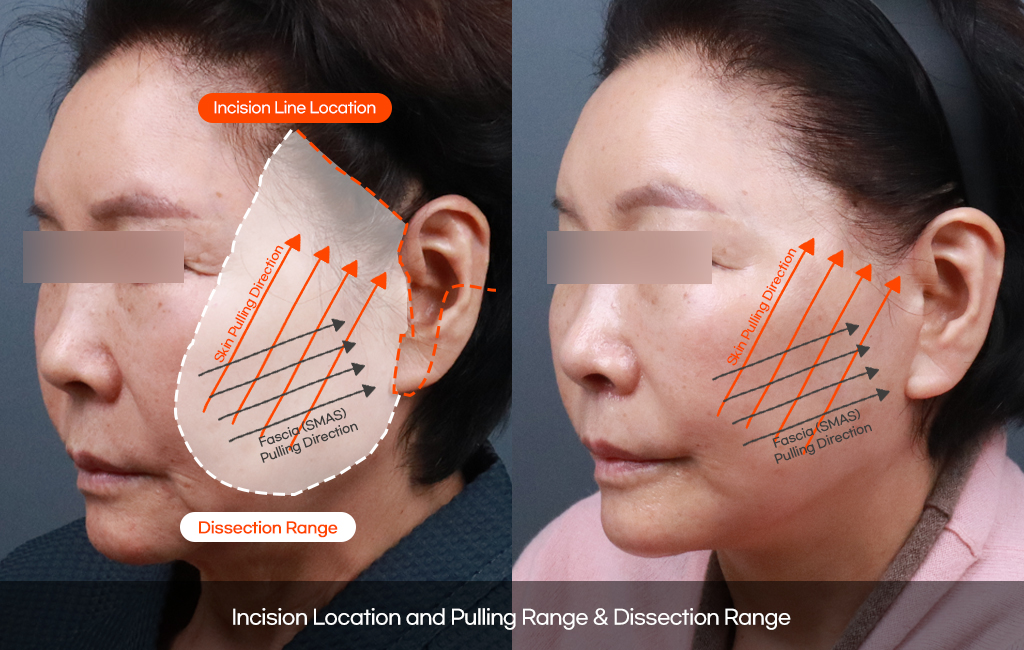
Uniform dissection without creating uneven skin,
separating adhered fascia and skin layers, avoiding
nerves while performing precise hemostasis—
The key to facelift revision surgery is identifying the
cause of the problem and improving the
unsatisfactory aspects of the previous surgery.
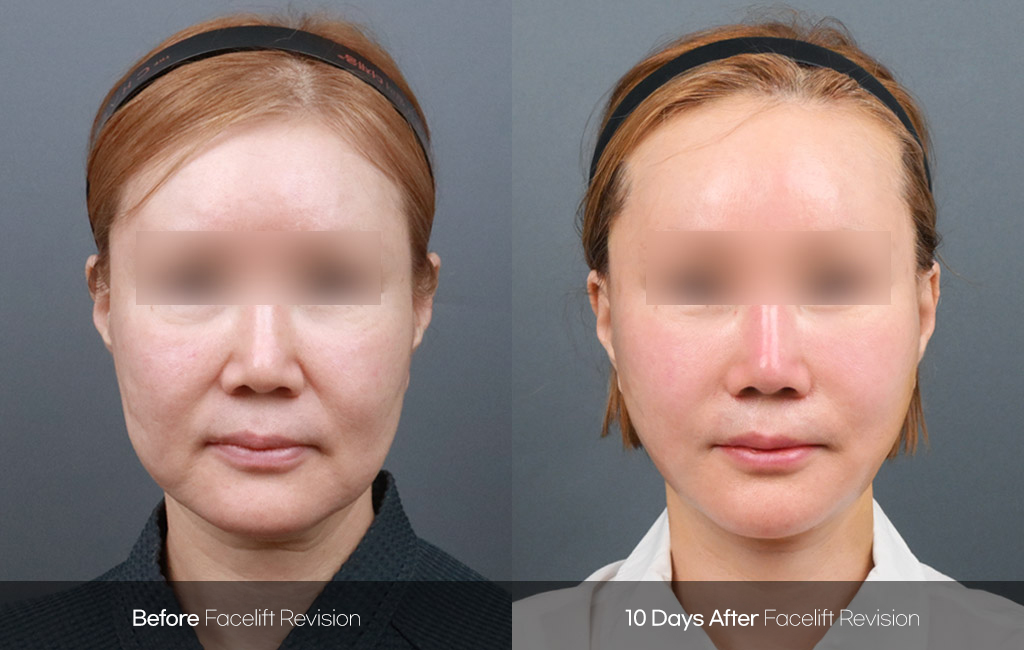
Face lift 02.
Lifting revision surgery cases—
Must start with cause analysis
Minimal Improvement Effects
In cases of severe tissue damage from previous
mini-lifts or thread lifting, or when sagging has
recurred over time after previous facelift surgery,
new lifting is performed through deep dissection
and precise SMAS layer dissection.
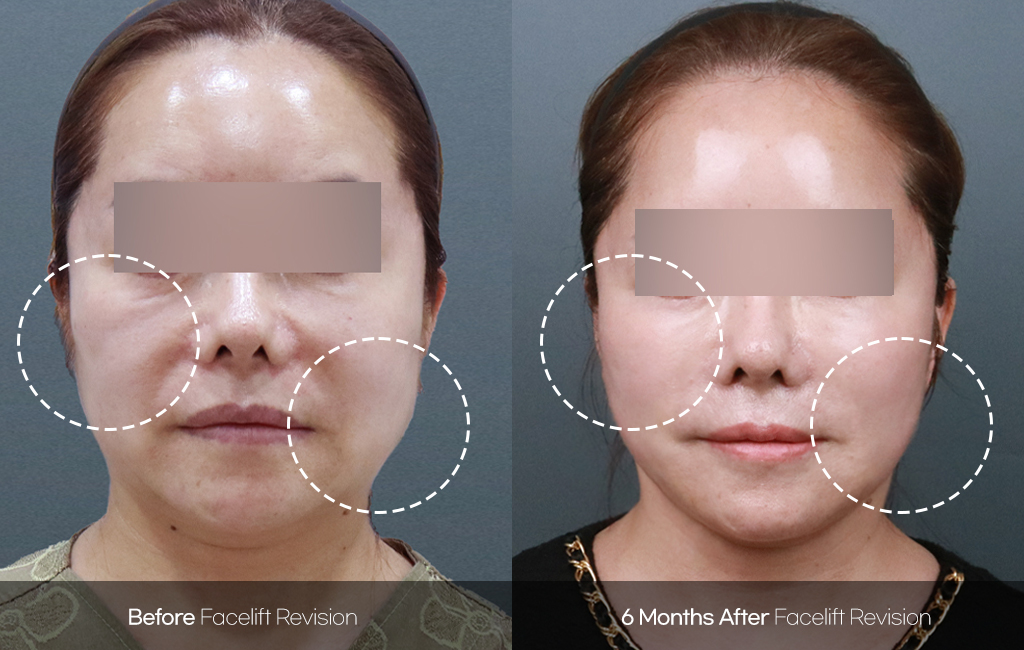
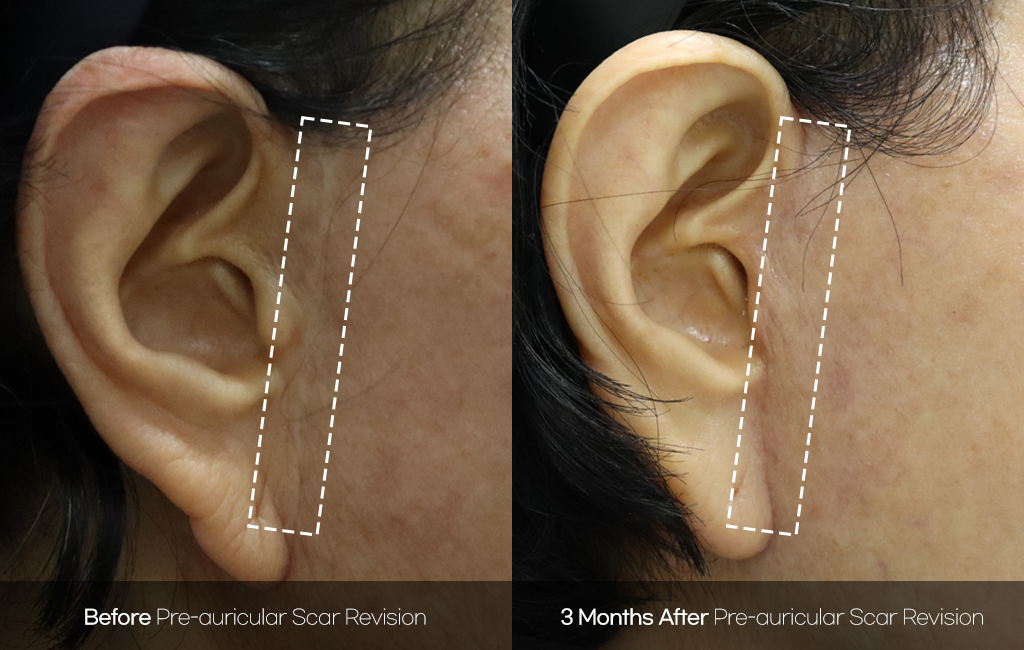
Pre-auricular and Post-auricular
Incision Scars
Scars from previous straight incisions or remaining
post-auricular incisions may develop incision site
scarring depending on skin tension.
During lifting revision surgery, new lifting is
performed while removing existing scars.
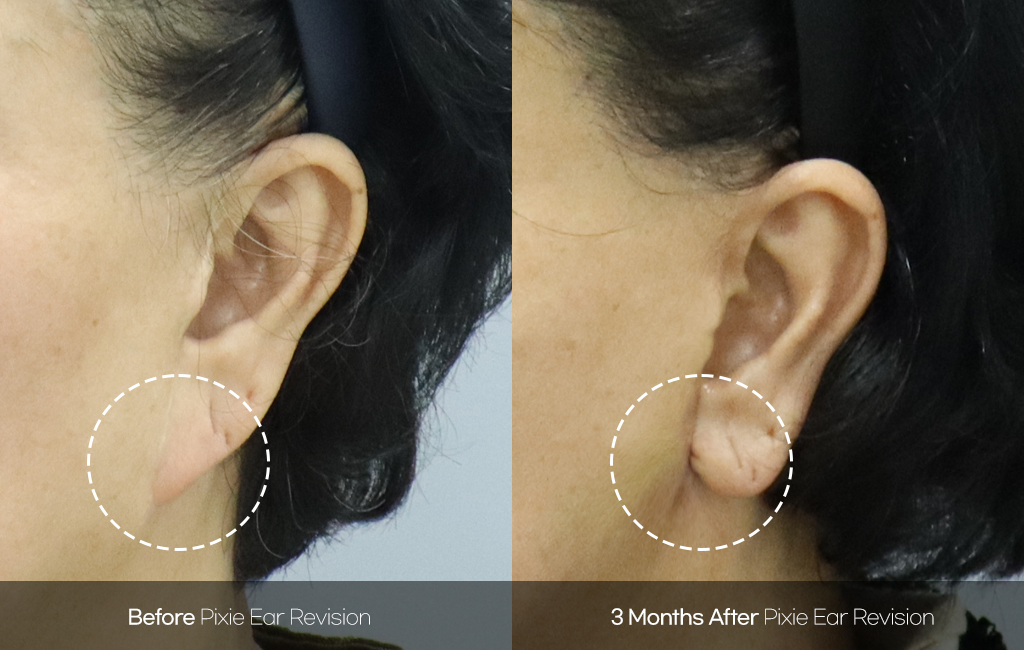
Pixie Ear Correction
Skin has the property of wanting to return to its
original state.
If pixie ear has developed, we create a natural
earlobe by reshaping the ear and creating an upper
fixation point.
Face lift 03.
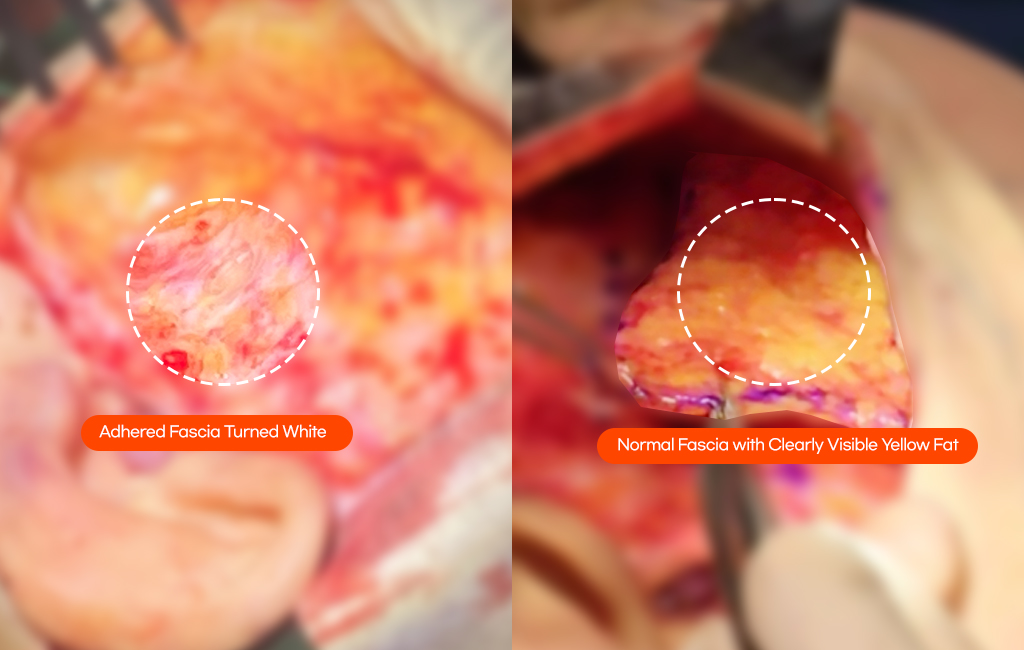
The most important dissection point
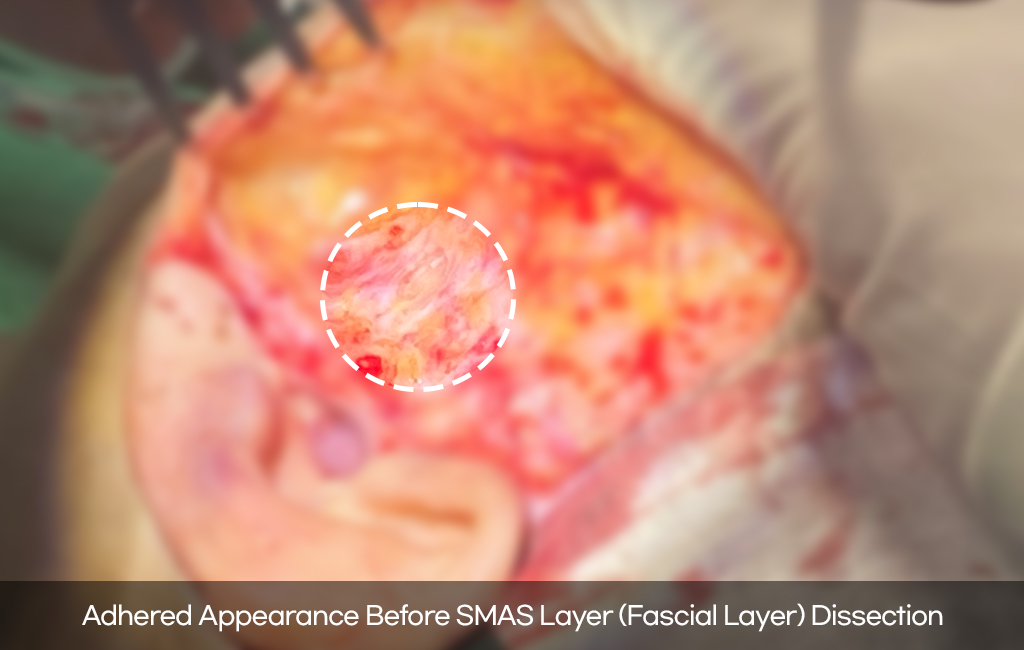
Those with previous surgery experience have all
tissues adhered together showing a white
appearance, while first-time surgery patients show
a yellow appearance with fat above the fascial layer.
Uniformly dissecting the fascial layer remaining in
the position called scar tissue is the key point in
lifting revision surgery.
Face lift 04.
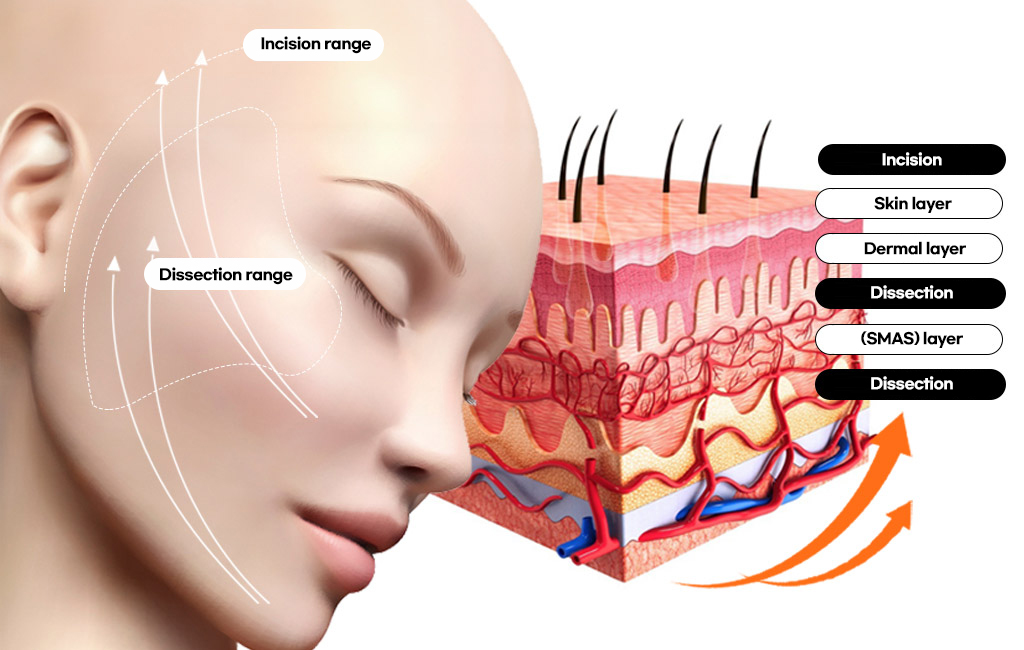
Dissection missed in the first surgery—
through revision surgery
Unlike the first surgery, facelift revision surgery
often has many adhered tissues and damaged
fascial layers.
Therefore, we dissect as widely and extensively as
possible while avoiding nerves and blood vessels,
lifting even areas missed in the first surgery to
extend revision surgery effects and improve
longevity further.
Face lift 05.
What makes Planet revision surgery
special—
Precise facial analysis expertise
through clinical experience
Surgical Plan According to Revision Cause
Since the reasons for revision surgery differ for each
person, we identify procedure and surgical history
before revision to find the most suitable surgery
and consult on the direction of lifting and
predictable post-surgical results.
Foreign Material Removal Analysis
Before revision surgery, many patients have
received multiple procedures such as thread lifting
or fillers for improvement.
All threads and fillers that interfere with dissection
are completely removed to complete smooth facial
lines without hindering surgery.
Surgical Direction Guidance
When revision surgery alone is insufficient, various
surgeries such as liposuction, fat grafting, double
chin muscle plication, neck lift, and forehead lift
may need to be performed concurrently.
In this process, we explain results according to
whether to proceed and recommend only
necessary surgeries with absolutely no excessive
treatment.
Face lift 06.
Recovery expertise—
Why Planet’s recovery is fast
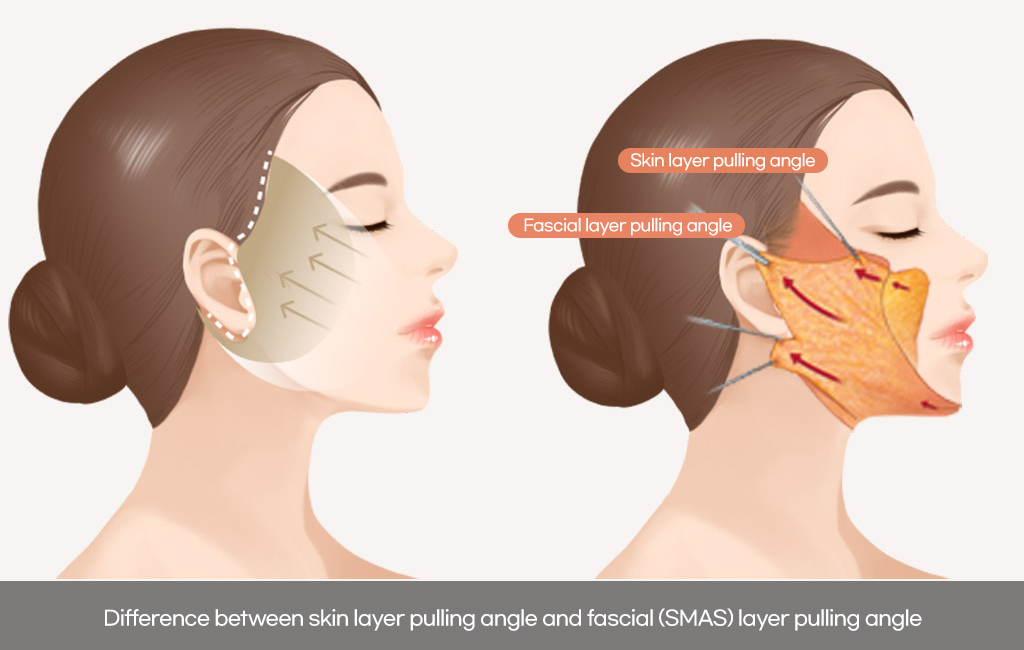
Most facelifts dissect through the middle of the subcutaneous layer to save time.
In such cases, blood vessels in the subcutaneous
layer may be damaged, and if too close to the skin
layer, unevenness or skin damage may occur.
Planet’s Dr. Shin Dong-woo dissects accurately and
uniformly along just above the SMAS layer and
performs immediate hemostasis when bleeding
occurs, enabling rapid recovery.
Face lift 07.
Scar concerns—Planet is with you.
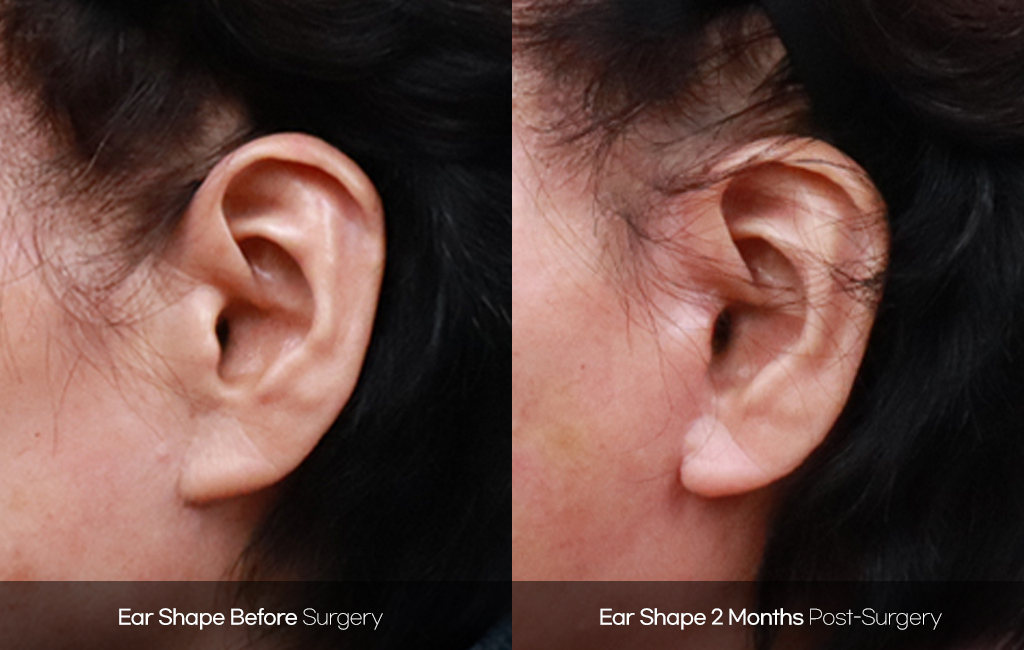
Dr. Shin Dong-woo maintains the ear shape by considering the tension on the skin.
To reduce scarring, tension on the skin must be reduced.
The incision is made behind the tragal cartilage,
removing skin while leaving only the minimum
amount that doesn’t restrict movement,
maintaining the ear shape as is.
Face lift 08.
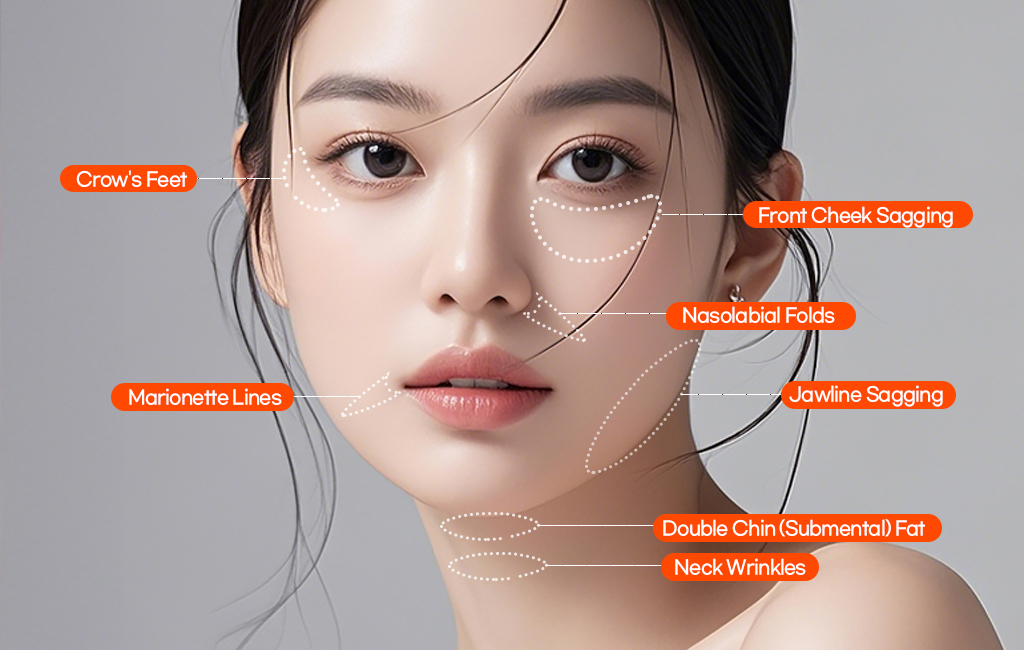
Lifting revision surgery is
recommended in these cases:
Face lift 09.
What effects can be achieved
with lifting revision surgery?
Face lift 10.
Lifting revision surgery
recovery process guide
Face lift 11.
Post-lifting revision surgery
medical aftercare process guide
Planet provides aftercare throughout this entire
schedule, with our dedicated team accompanying
you through all processes that occur during
recovery.
In addition to basic care, Planet helps rapid
recovery through the Golden Plan aftercare program.
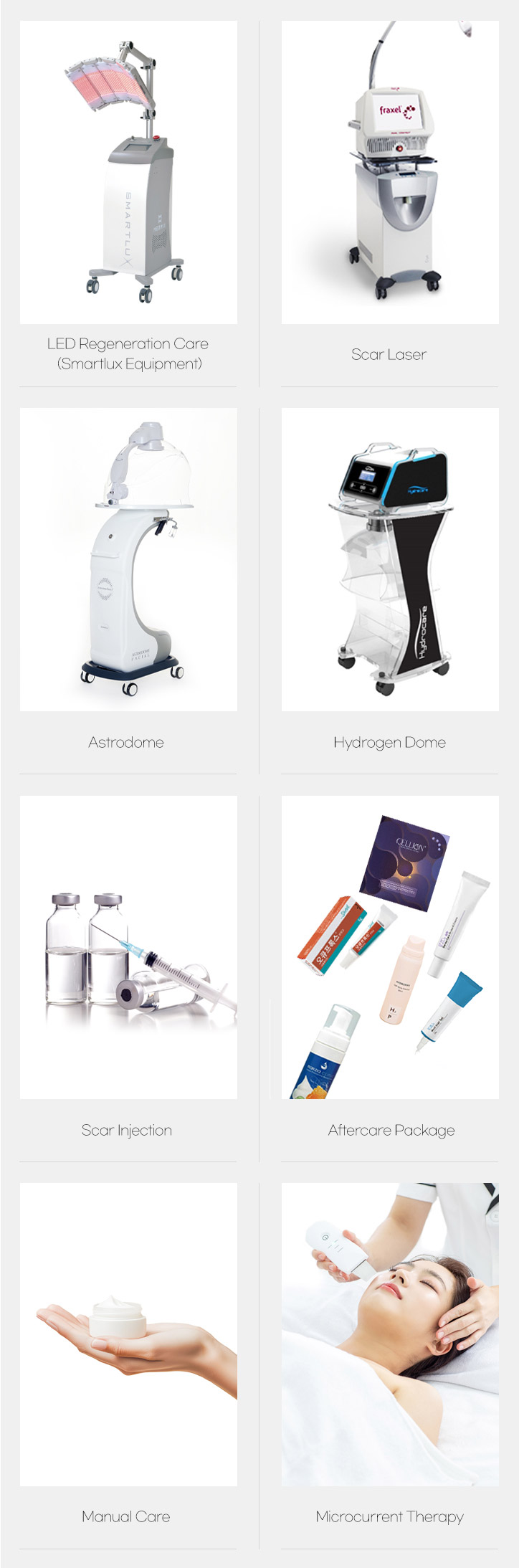
The Golden Plan aftercare program is a
personalized program that provides various
aftercare for up to 3 months according to recovery
status.
Golden Plan
Aftercare Program Schedule

Every revision at Planet is performed by Dr. Dong-woo Shin, a board-certified plastic surgeon with 17 years of surgical experience who has focused his practice exclusively on facial lifting procedures.
Planet does not rotate patients between surgeons: the doctor you meet at consultation is the doctor who operates and the doctor who sees you at every follow-up.
Revision is where experience matters most. Scar tissue from a previous lift or threads hides the layers a surgeon normally relies on, so the dissection has to be slower, wider and done by feel. Dr. Shin treats revision patients every week — many after thread lifts, some after two or three previous surgeries — and will tell you honestly what can and cannot be corrected before you travel.
What went wrong, and how it is corrected
Most revision patients arrive with one of the problems below. Find yours to see what caused it and what we do about it.
| Problem you notice | Usual cause | How Planet corrects it | Earliest timing |
|---|---|---|---|
| Sagging came back within 1–2 years | Skin-only lift or threads; SMAS was never repositioned | Full deep plane re-lift: release ligaments, reposition SMAS, remove old threads | 6 months after the previous surgery |
| Pulled, wind-swept or “operated” look | Skin pulled too tight in the wrong direction; SMAS not lifted | Release the tight skin flap, lift the SMAS vertically so the skin no longer carries the tension | 12 months |
| Visible or widened scars in front of the ear | Straight incision, closure under tension, or incision placed outside the tragus | Excise the old scar, re-position the incision behind the tragus, close without tension | 12 months |
| Pixie ear (earlobe pulled downward) | Earlobe attached under tension during closure | Release the earlobe, re-create the natural notch, fix the lobe to a new upper anchor point | 12 months |
| Lumps, dimples or uneven skin | Threads or sutures too close to the skin; uneven dissection | Remove threads in the SMAS layer, even out the dissection plane, fat grafting if needed | 6 months after threads, 12 months after surgery |
| Hairline moved or sideburn lost | Incision placed into the hairline and skin removed upward | Re-position the incision along the hairline; fat grafting or hair transplant referral for lost areas | 12 months |
| Persistent pain or foreign body feeling | Retained threads, knots or permanent sutures | Locate and remove the material during the re-lift | 3–6 months after threads |
| Hollow cheeks after a previous lift | Fat removed or compressed; volume loss with age | Deep plane lift combined with fat grafting to the midface | 12 months |
Timing is a general guide. Dr. Shin confirms the right time for you after reviewing your photos and surgical history.
Why we wait
Operating too early — before the previous scar has matured — makes the tissue harder to dissect and the result less predictable. If you contact us sooner, we will review your photos, tell you what we see, and schedule surgery for the right time rather than the earliest time.
What determines the cost of a revision facelift?
Revision is priced case by case, because no two previous surgeries left the same situation behind. Dr. Shin prepares your quote after reviewing your photos and the details of what was done before. Revision usually costs more than a first facelift because the dissection takes longer and often includes work that a first-time patient does not need.
Four things decide the final figure:
Every quote we send is all-inclusive. It covers:
Not included: flights, accommodation, and travel insurance.
There are no added fees after the quote, even if we find more scar tissue than expected during surgery. The figure you receive is the figure you pay.
Recovery varies by individual and by how much scar tissue was released. International patients can return home after stitch removal on Day 10; follow-up from 1 month onwards is done by photo.
Traveling to Korea for a revision facelift
Many of our revision patients had their first surgery abroad. Here is how to get an honest assessment before you book a flight.
Usually 12 months for a previous surgical facelift, and 6 months after a thread lift. The scar from the first surgery needs to mature before it can be dissected safely. If something is clearly wrong earlier — severe asymmetry, pain, or exposed threads — send photos anyway; some problems can be addressed sooner.
Yes. About 60% of our revision patients had their first surgery abroad. Send your photos and whatever you know about the previous procedure. An operative report helps but is not required; Dr. Shin can usually tell from the scars and the way the tissue moves what was done.
Yes. Threads that sit in the SMAS layer are located and removed during the revision lift, which is the only way to reach them. We do not recommend trying to remove threads through small incisions on their own; it usually leaves more scarring than the threads themselves.
In most cases, yes. The earlobe is released from the pulled position, the natural notch between lobe and cheek is re-created, and the lobe is anchored to a new point above so that it does not pull down again. It is done as part of the re-lift, not as a separate surgery.
Scars that sit in front of the tragus, run in a straight line, or widened under tension can be excised and re-closed behind the tragus without tension. The new line is thinner and hidden in the ear’s natural curve. A scar cannot be erased completely, but it can be made hard to find.
The surgery is more complex because scar tissue hides the layers a surgeon normally sees, so dissection is slower and nerves have to be protected by feel. In experienced hands the risk is comparable to a first facelift; the difference is surgical time, which is why Dr. Shin schedules one revision per day with no other surgery after it.
10–12 days. Stitches are removed on Day 7 and Day 10, and when scar revision or pixie ear correction is included we ask you to stay two more days so the ear can be checked once more before you fly.
Then we will tell you that before you travel. Part of every revision assessment is a plain statement of what can be corrected, what will improve only partly, and what should be left alone. We would rather lose a booking than operate on someone who should not have surgery.
Medically reviewed by Dr. Dong-woo Shin, Plastic Surgeon · Last updated October 2026
Lifting Revision Surgery
Surgery for those who need revision due to sagging, scarring,
side effects, or minimal results after previous anti-aging surgery.
Dr. Shin Dong-woo conducts Planet’s unique lift surgery by
enhancing the advantages and complementing the disadvantages
of each surgical method through continuous research to achieve
enhanced recovery and superior facelift results.
Face Lift 01.
Lifting revision surgery—Why is it challenging?
When performing facelift revision surgery, there are many areas
damaged from previous surgery.
Some patients have had thread lifting after their first lift surgery,
with skin, fascia, and dermal layers adhered to each other.
Uniform dissection without creating uneven skin,
separating adhered fascia and skin layers,
avoiding nerves while performing precise hemostasis—
The key to facelift revision surgery is identifying the cause
of the problem and improving the unsatisfactory aspects
of the previous surgery.
Face Lift 02.
Lifting revision surgery cases—Must start with cause analysis
Minimal Improvement Effects
In cases of severe tissue damage from previous mini-lifts or thread lifting,
or when sagging has recurred over time after previous facelift surgery,
new lifting is performed through deep dissection and precise SMAS layer dissection.
Pre-auricular and Post-auricular Incision Scars
Scars from previous straight incisions or remaining post-auricular incisions
may develop incision site scarring depending on skin tension.
During lifting revision surgery, new lifting is performed while
removing existing scars.
Pixie Ear Correction
Skin has the property of wanting to return to its original state.
If pixie ear has developed, we create a natural earlobe by
reshaping the ear and creating an upper fixation point.
Face Lift 03.
The most important dissection point
Those with previous surgery experience have all tissues adhered together
showing a white appearance, while first-time surgery patients show
a yellow appearance with fat above the fascial layer.
Uniformly dissecting the fascial layer remaining in the position
called scar tissue is the key point in lifting revision surgery.
Face Lift 04.
Dissection missed in the first surgery—through revision surgery
Unlike the first surgery, facelift revision surgery often has
many adhered tissues and damaged fascial layers.
Therefore, we dissect as widely and extensively as possible while
avoiding nerves and blood vessels, lifting even areas missed in
the first surgery to extend revision surgery effects and improve
longevity further.
Face Lift 05.
What makes Planet revision surgery special—
Precise facial analysis expertise through clinical experience
Surgical Plan According to Revision Cause
Since the reasons for revision surgery differ for each person,
we identify procedure and surgical history before revision to find
the most suitable surgery and consult on the direction of lifting
and predictable post-surgical results.
Foreign Material Removal Analysis
Before revision surgery, many patients have received multiple
procedures such as thread lifting or fillers for improvement.
All threads and fillers that interfere with dissection are
completely removed to complete smooth facial lines without
hindering surgery.
Surgical Direction Guidance
When revision surgery alone is insufficient, various surgeries such
as liposuction, fat grafting, double chin muscle plication, neck lift,
and forehead lift may need to be performed concurrently.
In this process, we explain results according to whether to proceed
and recommend only necessary surgeries with absolutely no
excessive treatment.
Face Lift 06.
Recovery expertise—Why Planet’s recovery is fast
Most facelifts dissect through the middle of the subcutaneous layer
to save time. In such cases, blood vessels in the subcutaneous layer
may be damaged, and if too close to the skin layer, unevenness
or skin damage may occur.
Planet’s Dr. Shin Dong-woo dissects accurately and uniformly
along just above the SMAS layer and performs immediate hemostasis
when bleeding occurs, enabling rapid recovery.
Face Lift 07.
Scar concerns—Planet is with you.
Dr. Shin Dong-woo maintains the ear shape by considering the tension
on the skin. To reduce scarring, tension on the skin must be reduced.
The incision is made behind the tragal cartilage, removing skin while
leaving only the minimum amount that doesn’t restrict movement,
maintaining the ear shape as is.
Face Lift 08.
Lifting revision surgery is recommended in these cases:
Face Lift 09.
What effects can be achieved with lifting revision surgery?
Face Lift 10.
Lifting revision surgery recovery process guide
Face Lift 11.
Post-lifting revision surgery medical aftercare process guide
Planet provides aftercare throughout this entire schedule,
with our dedicated team accompanying you through all processes
that occur during recovery.
In addition to basic care, Planet helps rapid recovery through the
Golden Plan aftercare program. The Golden Plan aftercare program
is a personalized program that provides various aftercare for up to
3 months according to recovery status.
Golden Plan Aftercare Program Schedule
Every revision at Planet is performed by Dr. Dong-woo Shin, a board-certified plastic surgeon with 17 years of surgical experience who has focused his practice exclusively on facial lifting procedures.
Planet does not rotate patients between surgeons: the doctor you meet at consultation is the doctor who operates and the doctor who sees you at every follow-up.
Revision is where experience matters most. Scar tissue from a previous lift or threads hides the layers a surgeon normally relies on, so the dissection has to be slower, wider and done by feel. Dr. Shin treats revision patients every week many after thread lifts, some after two or three previous surgeries and will tell you honestly what can and cannot be corrected before you travel.
What went wrong, and how it is corrected
Most revision patients arrive with one of the problems below. Find yours to see what caused it and what we do about it.
| Problem you notice | Usual cause | How Planet corrects it | Earliest timing |
|---|---|---|---|
| Sagging came back within 1–2 years | Skin-only lift or threads; SMAS was never repositioned | Full deep plane re-lift: release ligaments, reposition SMAS, remove old threads | 6 months after the previous surgery |
| Pulled, wind-swept or “operated” look | Skin pulled too tight in the wrong direction; SMAS not lifted | Release the tight skin flap, lift the SMAS vertically so the skin no longer carries the tension | 12 months |
| Visible or widened scars in front of the ear | Straight incision, closure under tension, or incision placed outside the tragus | Excise the old scar, re-position the incision behind the tragus, close without tension | 12 months |
| Pixie ear (earlobe pulled downward) | Earlobe attached under tension during closure | Release the earlobe, re-create the natural notch, fix the lobe to a new upper anchor point | 12 months |
| Lumps, dimples or uneven skin | Threads or sutures too close to the skin; uneven dissection | Remove threads in the SMAS layer, even out the dissection plane, fat grafting if needed | 6 months after threads, 12 months after surgery |
| Hairline moved or sideburn lost | Incision placed into the hairline and skin removed upward | Re-position the incision along the hairline; fat grafting or hair transplant referral for lost areas | 12 months |
| Persistent pain or foreign body feeling | Retained threads, knots or permanent sutures | Locate and remove the material during the re-lift | 3–6 months after threads |
| Hollow cheeks after a previous lift | Fat removed or compressed; volume loss with age | Deep plane lift combined with fat grafting to the midface | 12 months |
Timing is a general guide. Dr. Shin confirms the right time for you after reviewing your photos and surgical history.
Why we wait
Operating too early before the previous scar has matured makes the tissue harder to dissect and the result less predictable. If you contact us sooner, we will review your photos, tell you what we see, and schedule surgery for the right time rather than the earliest time.
What determines the cost of a revision facelift?
Revision is priced case by case, because no two previous surgeries left the same situation behind. Dr. Shin prepares your quote after reviewing your photos and the details of what was done before. Revision usually costs more than a first facelift because the dissection takes longer and often includes work that a first-time patient does not need.
Four things decide the final figure:
Every quote we send is all-inclusive. It covers:
Not included: flights, accommodation, and travel insurance.
There are no added fees after the quote, even if we find more scar tissue than expected during surgery. The figure you receive is the figure you pay.
Recovery varies by individual and by how much scar tissue was released. International patients can return home after stitch removal on Day 10; follow-up from 1 month onwards is done by photo.
Traveling to Korea for a revision facelift
Many of our revision patients had their first surgery abroad. Here is how to get an honest assessment before you book a flight.
Usually 12 months for a previous surgical facelift, and 6 months after a thread lift. The scar from the first surgery needs to mature before it can be dissected safely. If something is clearly wrong earlier — severe asymmetry, pain, or exposed threads — send photos anyway; some problems can be addressed sooner.
Yes. About 60% of our revision patients had their first surgery abroad. Send your photos and whatever you know about the previous procedure. An operative report helps but is not required; Dr. Shin can usually tell from the scars and the way the tissue moves what was done.
Yes. Threads that sit in the SMAS layer are located and removed during the revision lift, which is the only way to reach them. We do not recommend trying to remove threads through small incisions on their own; it usually leaves more scarring than the threads themselves.
In most cases, yes. The earlobe is released from the pulled position, the natural notch between lobe and cheek is re-created, and the lobe is anchored to a new point above so that it does not pull down again. It is done as part of the re-lift, not as a separate surgery.
Scars that sit in front of the tragus, run in a straight line, or widened under tension can be excised and re-closed behind the tragus without tension. The new line is thinner and hidden in the ear’s natural curve. A scar cannot be erased completely, but it can be made hard to find.
The surgery is more complex because scar tissue hides the layers a surgeon normally sees, so dissection is slower and nerves have to be protected by feel. In experienced hands the risk is comparable to a first facelift; the difference is surgical time, which is why Dr. Shin schedules one revision per day with no other surgery after it.
10–12 days. Stitches are removed on Day 7 and Day 10, and when scar revision or pixie ear correction is included we ask you to stay two more days so the ear can be checked once more before you fly.
Then we will tell you that before you travel. Part of every revision assessment is a plain statement of what can be corrected, what will improve only partly, and what should be left alone. We would rather lose a booking than operate on someone who should not have surgery.
Medically reviewed by Dr. Dong-woo Shin, Plastic Surgeon · Last updated October 2026