



Hello, I’m Dr. Shin Dong-woo, the leading surgeon at Planet Plastic Surgery Clinic.
Every day, patients walk into my office holding before-and-after photos from our clinic, their eyes bright with anticipation.
What I find fascinating is this: almost all of them say they are looking to get a “Mini Facelift.” However, when they point to the dramatic, crisp jawline results in our lookbook, they are actually pointing to the outcome of our signature technique—the Mini-Plus Lifting.
A conventional mini facelift is highly popular online, but it has distinct anatomical boundaries. To help you make an informed decision and avoid surgical regret, I want to share an honest, straightforward breakdown of traditional mini facelifts, their hidden limitations, and why we developed the Mini-Plus Lifting as a smarter evolution.
Mini Facelift Reviews: Is It the Right Choice for Everyone?
A traditional mini facelift works through a small incision made around the front of the ear. Through this limited window, the surgeon tightens both the surface skin and a portion of the deeper connective tissue, known as the SMAS (Superficial Muscular Aponeurotic System) layer.
Because it targets a smaller area than a full facelift, it offers a faster recovery time, making it highly appealing to patients in their 20s and 30s or those experiencing the very first signs of facial aging.
⭕ When a Mini Facelift Works Well:
- Early structural jowling or mild loss of jawline definition.
- Mild, shallow nasolabial folds.
- Patients with relatively good skin elasticity who require minimal tissue repositioning.
❌ The Hidden Limitations of a Traditional Mini Lift:
However, many online mini facelift reviews fail to mention its strict limitations. Because the surgical incision is small, there is a natural ceiling to how much sagging tissue can actually be visualized and lifted.
If a surgeon tries to force a dramatic result through a restricted incision by pulling the skin too hard, it can lead to complications:
- Skin bunching or puckering near the ear.
- Sunken or unnatural dents in the midface.
- Wide, visible scarring caused by excessive tension on the skin closure.
For individuals with moderate-to-severe sagging, significant skin laxity after weight loss, or sagging accelerated by facial bone surgery (contouring/orthognathic surgery), a traditional mini facelift often falls short of expectations.
The Evolution: What is Planet’s “Mini-Plus Lifting”?
Witnessing patients undergo multiple mini lifts only to be disappointed by short-lived results, I kept asking myself: “How can we safely access a wider, deeper plane of the sagging tissue without the extensive recovery of a full facelift?”
The answer was the development of the Mini-Plus Lifting.
[Traditional Mini Incision] -> Limited to the front of the ear (Narrow lifting vector)
[Mini-Plus Incision]        -> Extends slightly along the hairline (Wide, deep SMAS lifting vector)
The key differentiator lies in the strategic incision design. By subtly extending the incision along the hairline, we gain significantly more internal visibility. This allows us to release key retaining ligaments, access the deeper SMAS layers across a broader area, and anchor the sagging tissue far more securely.
Case Study: Turning a Heavy Midface into a Crisp Jawline
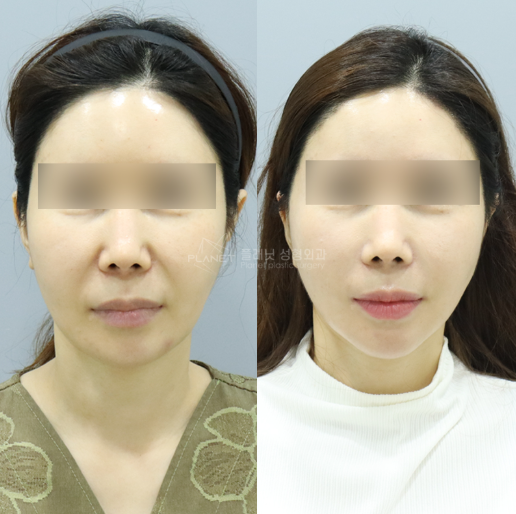
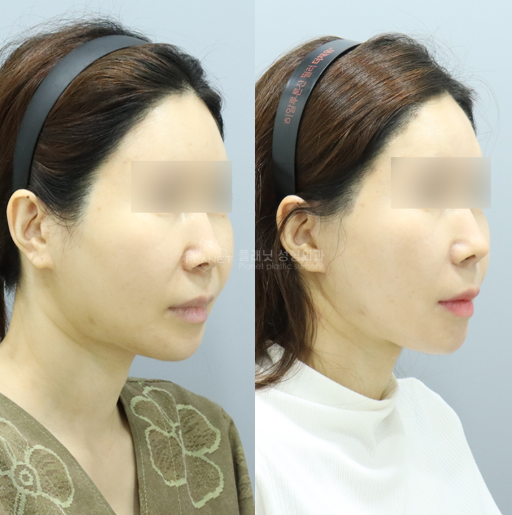
A female patient recently visited Planet Clinic with heavy, sagging cheeks and a poorly defined lower face. She had been told elsewhere that a standard mini lift was her only option due to her age. However, her tissue laxity was too widespread for a narrow incision to fix.
Using the Mini-Plus Lifting technique, we successfully lifted and repositioned the root causes of her sagging. Her midface weight was redistributed upward to create youthful volume in her cheeks, her jawline sharpened cleanly all the way to her chin, and her nasolabial folds softened naturally. Most importantly, she didn’t look “pulled” or unnatural—she just looked like a refreshed version of herself.
Head-to-Head: Traditional Mini Facelift vs. Mini-Plus Lifting
| Comparison Factor | Traditional Mini Facelift | Planet’s Mini-Plus Lifting |
| Incision Placement | Strictly restricted around the ear | Discretely extended along the hairline & ear |
| SMAS Dissection Area | Narrow & localized | Wide & Deep (Broader surgical field) |
| Target Concerns | Very mild jowls, early aging | Heavy cheeks, sagging jawline, deep mouth lines |
| Result Longevity | Short-term (Often fades within 1–2 years) | Long-term & Stable (Multi-year durability) |
| Natural Appearance | Risk of skin tension or puckering if over-pulled | Natural contouring via tension-free skin closure |
Conclusion: Look Beyond the Surface of Before-and-After Reviews
When researching mini facelift reviews and scrolling through before-and-after photos online, it is crucial to look deeper than the immediate surface change. Ask yourself the critical questions:
- Did the surgeon actually lift the root deep tissues, or did they just pull the skin?
- Is the technique robust enough to offer stable, long-lasting support?
Nobody undergoes facial rejuvenation hoping the results will fade in a year. If your facial sagging spans across a broader area of your mid-to-lower face, or if you desire a definitive, long-lasting transformation without a full-incision facelift, Mini-Plus Lifting is engineered to be the complete answer.
The definitive way to avoid surgical regret is to receive an accurate, anatomical diagnosis of your face.
If you have any questions about choosing between a traditional mini lift and our advanced Mini-Plus technique, please leave a comment below or connect with the Planet Plastic Surgery Clinic team directly. We are always here to guide you toward the safest, most effective path for your face.
Thank you for your time.
Written by Dr. Shin Dong-woo, Leading Surgeon at Planet Plastic Surgery Clinic.
FAQ
A. The primary differences lie in the incision design and the depth of internal dissection. A traditional mini facelift utilizes a restricted incision confined strictly to the front of the ear, which limits visibility and offers a narrow lifting vector. Conversely, Mini-Plus Lifting discreetly extends the incision along the hairline. This expanded structural view allows us to release key retaining ligaments and perform a wider, deeper dissection of the SMAS (muscular) layer, delivering a far more dramatic and long-lasting lower face transformation.
A. Longevity depends entirely on the surgical technique used. A conventional mini lift that only pulls the skin or provides localized tightening generally holds up for about 1 to 2 years before soft tissues begin to drop again. Because Mini-Plus Lifting reshapes and anchors the deep SMAS layer across a broader area, it eliminates the root cause of structural sagging, allowing the crisp jawline and lifted cheeks to remain stable and youthfully defined for up to several years.
A. No, when performed with advanced surgical precision. The extended hairline incision used in Mini-Plus Lifting is meticulously placed to follow the natural contours of your hair, rendering it virtually invisible once healed. Furthermore, wide scarring occurs when surface skin is pulled too tight. At Planet Clinic, we absorb the lifting tension entirely within the deep SMAS layer, allowing the surface skin to be closed under zero tension. This prevents scar stretching, puckering, or distortion of the ear anatomy.
A. Surgical candidacy is determined by anatomical skin condition, not the number on your birth certificate. While facelifts are traditionally associated with older demographics, many patients in their 20s and 30s experience widespread facial sagging due to rapid weight loss (such as “Wegovy Face”) or tissue laxity following facial bone contouring surgeries. If your tissue descent spans a broader area of the mid-to-lower face, a limited mini lift will fall short, making the Mini-Plus Lifting a much more accurate and definitive solution regardless of your age.
A. Because the dissection is highly targeted compared to a traditional full facelift, recovery is significantly shorter. Major swelling and bruising typically resolve within 7 to 10 days, which is when your sutures are removed. Most patients can comfortably return to work, wear light makeup, and resume social activities immediately after suture removal. While minor residual swelling will continuously subside over 1 to 3 months, your final, refined facial contours will be clearly visible by week two.