



In my consultation room, the most common phrase I hear is: “Doctor, I know the results of an incision lift are amazing, but I’m terrified of the scars.”
I completely understand. The thought of having an incision on your face is naturally daunting. However, I often tell my patients one thing: once they see the actual “before and after” photos of the recovery process, most of those fears disappear.
The secret isn’t in the surgery’s name, but in the “how.” Even with the same procedure, the visibility of a scar depends entirely on the surgeon’s technique. Today, I’ll share the specific methods I use to minimize scarring and achieve what we call “invisible” results.
Why Do Some Scars Stand Out?
Many believe that an incision automatically equals a permanent, visible mark. This is only half-true. While an incision always leaves a trace, whether that trace remains a “noticeable scar” or heals into an “invisible line” depends on three factors:
1. Incision Placement (The Art of Hiding)
Where the cut is made determines if the mark is exposed or naturally hidden within the facial contours.
2. Suturing Technique (The Craft of Closing)
The precision of the closure affects the thickness and color of the final scar.
3. Tension Management (The Science of Balance)
Distributing the “pull” of the skin evenly is crucial. If the skin is pulled too tight at the incision line, the scar will widen.
The Secret: The “Retro-Tragal” Incision
Most clinics perform a “Pre-Tragal” incision (in front of the ear) because it’s easier and faster. However, data from the American Society of Plastic Surgeons (ASPS) shows that patient satisfaction regarding scars is 60% higher when using a Retro-Tragal incision (behind the ear cartilage).
- Behind the Tragus: We hide the incision behind the small bump of cartilage in front of your ear canal.
- The Difficulty: This area is incredibly thin and delicate. It takes twice as long to perform because we must preserve the natural shape of your ear cartilage with 1mm precision.
Many surgeons avoid this to save time, but for the patient, it’s the difference between a hidden scar and a visible one.
How We Achieve “Invisible” Healing: My 3 Pillars
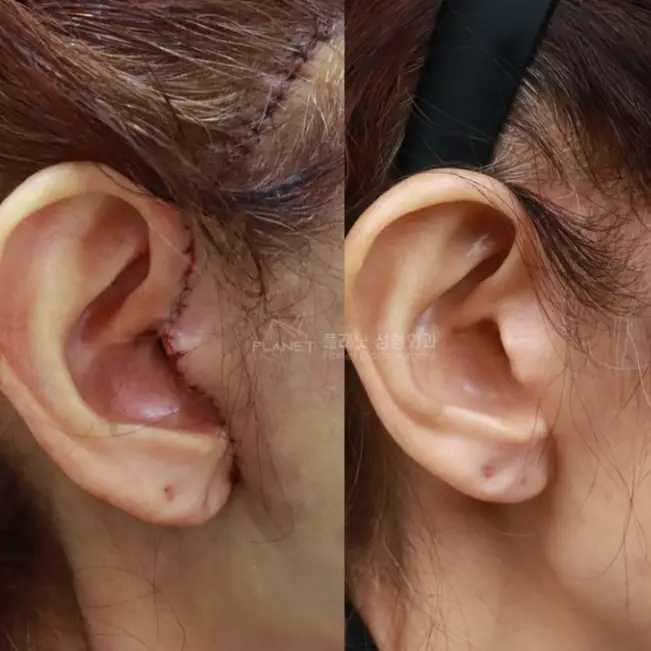
■ Triple-Layer Suturing (Multi-Layer Closure)
Your skin isn’t just one layer. I close the wound in three distinct stages:
- The SMAS Layer: Secured firmly with deep stitches to hold the structural weight.
- The Dermis: Closed with mid-sized thread to align the skin edges.
- The Epidermis (Surface): Finished with a thread as thin as a hair for a seamless look. By dividing the tension across these layers, the surface skin feels almost no “pull,” allowing it to heal into a faint, flat line.
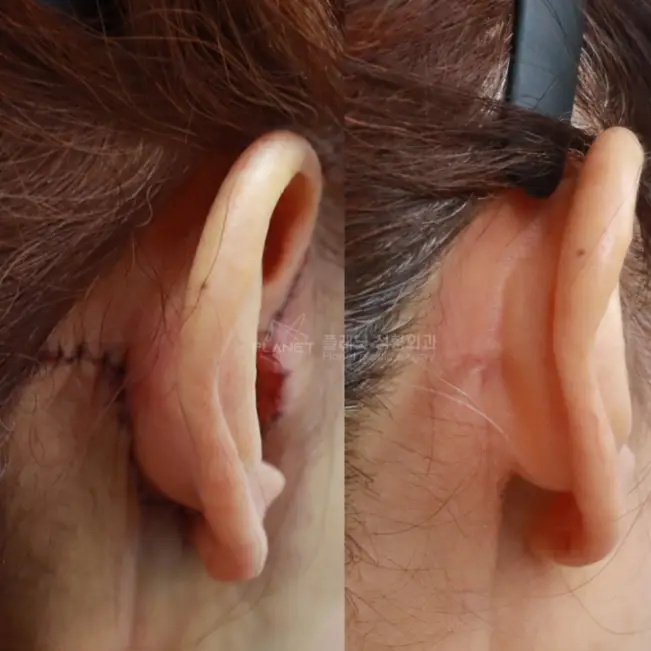
■ 0.3mm Micro-Spacing
Consistency is everything. If stitches are uneven by even 0.3mm, the incision line becomes jagged or “bumpy.” I dedicate an extra 10 to 20 minutes solely to ensuring each stitch is perfectly spaced. This prevents the skin from bunching up and ensures a smooth recovery.
■ Proactive Post-Op Recovery
Healing doesn’t end in the OR. We provide specialized ointments and cleansing protocols to ensure the scar “matures” properly. At Planet Plastic Surgery, we provide customized aesthetic aftercare for up to 3 months to monitor your skin’s regeneration.
Conclusion: Quality Over Quantity
All these steps—the hidden incisions, the triple-layer suturing, the micro-spacing—take an immense amount of time and energy. This is why I only perform one surgery per day.
I refuse to rush. My focus belongs entirely to one patient to ensure that every millimeter is perfect. If you are hesitating because of scar concerns, remember: Scars are a manageable variable. When choosing your clinic, ask: Do they use the Retro-Tragal technique? Do they perform multi-layer suturing? Do they limit their daily surgeries to focus on detail?
I provide a transparent surgical plan for every patient, explaining exactly where the incision goes and how the closure will look. Transparency is the best way to ensure your peace of mind.
FAQ
A: By using the Retro-Tragal incision and hiding the line behind the ear and along the hairline, the scars are designed to be virtually undetectable, even with your hair pulled back.
A: Initially, the line may appear pink. However, with our multi-layer suturing and 3-month aftercare program, most scars fade into a thin, skin-colored line that is hard to see within 3 to 6 months.
A: It requires navigating the thin cartilage of the ear without distorting its shape. It’s a meticulous process that requires a surgeon’s steady hand and significant time, which is why “factory-style” clinics often avoid it.