



Hello, I’m Dr. Shin Dong-woo, the leading surgeon at Planet Plastic Surgery Clinic.
Recently, a post I shared about thread lifting generated an overwhelming wave of questions from readers. Among the hundreds of inquiries, two specific questions stood out more than any other:
- “Is a non-surgical thread lift enough to fix my sagging skin?”
- “Do I actually need to jump straight into a surgical facelift?”
At the heart of both questions is the exact same goal: finding the most effective, long-lasting solution for your specific anatomy.
Before making a decision, it is vital to understand that there is no universal “right answer” in facial rejuvenation. Even two patients of the exact same age can require completely different approaches depending on their skin thickness, residual elasticity, and the structural depth of their facial aging.
Rather than walking you through dry medical theories, I would like to share real patient cases from my clinic to help you clarify which path is right for you.
When is a Thread Lift Enough? (The Non-Surgical Solution)
As a surgeon, I firmly believe in an honest approach: I never recommend a scalpel when a non-surgical method can achieve the desired outcome. Often, a lighter, minimally invasive touch is exactly what a patient needs.
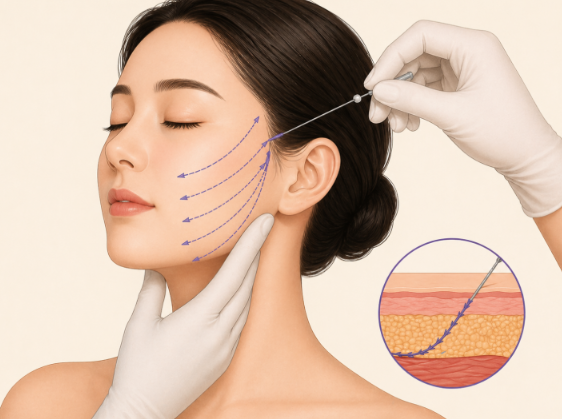
A perfect example is a 32-year-old female patient who visited my clinic recently. She noticed early signs of a drooping jawline, but her skin retained excellent elasticity, and the folds around her mouth were relatively shallow. For a foundation like hers, an aggressive surgery is entirely unnecessary. A strategically mapped thread lift can deliver a beautifully refreshed, contoured jawline without a single incision.
📌 Ideal Candidates for a Thread Lift:
- Age Demographic: Generally younger individuals (20s to late 30s/early 40s).
- Skin Condition: Excellent underlying skin resilience and collagen support.
- Degree of Laxity: Mild to early-moderate sagging of the cheeks and jawline.
A thread lift works by anchoring sagging soft tissue with barbed temporary sutures and gently lifting them back into place. If you fit this profile, choosing a less invasive option is the smartest, most efficient solution.
When is a Facelift the Better Choice? (The Structural Solution)
Conversely, there is a clear threshold where thread lifting completely hits its clinical limit.
Another patient came to my office after having undergone more than three thread lifts over the past five years. While she was pleased with the initial outcome of her first procedure, the subsequent lifts yielded diminishing returns. Her jawline would sag within months, and her hollow cheeks returned almost immediately, leaving her deeply frustrated by the repetitive cycle.
Upon clinical examination, the root cause was obvious: her facial skin had stretched out significantly, the tissues had thinned, and most importantly, the SMAS (Superficial Muscular Aponeurotic System) layer—the deep muscular architecture beneath the skin—had dropped dramatically.
A thread lift cannot remove excess, stretched skin, nor can it permanently lift the heavy, descended SMAS layer. When facial aging progresses past a certain point, threads simply cannot hold the weight of the sagging tissue. A surgical Facelift, by contrast, physically tightens the deep SMAS framework and excises the sagging excess skin for a fundamental, long-term correction.
📌 Ideal Candidates for a Facelift:
- Structural Laxity: Significant loss of definition along the jawline and lower face (severe jowls).
- Skin Excess: Noticeable amounts of loose, stretched-out skin that cannot shrink back.
- Aging Depth: Visible drooping of the midface, deep nasolabial folds, and marionette lines.
- Goal: A stable, definitive result that lasts for a decade or more.
After discussing these anatomical realities honestly, this patient opted for a facelift. The procedure went smoothly, and she was thrilled to finally see a permanent, natural-looking lift whenever she looked in the mirror.
The Hidden Risk: Having Multiple Thread Lifts Before a Facelift
If you are currently considering multiple thread lifts as a way to delay a facelift, there is one critical factor you must know.
Performing a facelift on a patient who has a history of multiple thread lifts makes the surgery significantly more complex than a primary case. Over time, dissolving or permanent threads induce localized inflammation, creating tight scar tissue and internal adhesions beneath the skin.
- The Surgical Challenge: Thick, barbed threads often fuse with the delicate SMAS layer and surrounding facial nerves. Safely dissecting and removing these threads without damaging the surrounding tissue requires exceptional surgical precision.
- Impact on Results: If previous threads have scarred or thinned out the underlying SMAS layer, it can compromise the structural integrity needed for an optimal surgical lift.
Therefore, if you are planning a facelift and have already undergone multiple thread lifts, it is imperative to choose a board-certified plastic surgeon with extensive experience in handling complex, scar-involved revision cases.
At-a-Glance: Facelift vs. Thread Lift Comparison
| Factor | Thread Lift (Non-Surgical) | Facelift (Surgical SMAS Lift) |
| Primary Target | Superficial soft tissue relocation | Deep SMAS layer repositioning + Excess skin removal |
| Anatomical Indication | Mild sagging, high skin elasticity | Moderate to severe sagging, loose skin, deep folds |
| Incisions & Scars | None (Needle puncture entry points only) | Minimal incisions hidden along the hairline & ear |
| Downtime | Rapid (1–3 days) | Moderate (1–2 weeks for swelling/bruising) |
| Longevity | Temporary (Approx. 6 months to 1 year) | Long-lasting (Typically 10+ years) |
Conclusion: Stop Relying on Trends; Focus on Your Anatomy
To summarize, thread lifts and facelifts are not competing treatments. They are separate tools engineered for completely different stages of the facial aging process.
The optimal decision should never be based on viral internet trends or someone else’s before-and-after photos. It must be determined by a precise, hands-on evaluation of your skin’s remaining elasticity and structural descent.
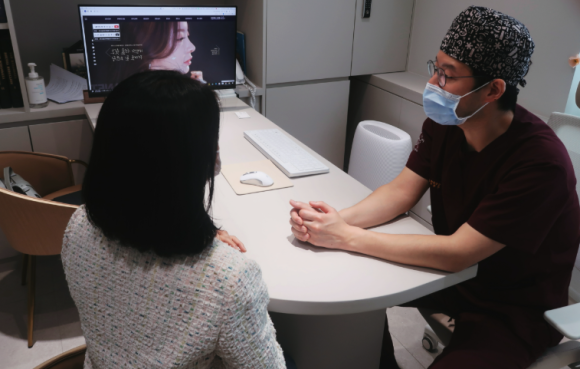
If you are feeling stuck between a non-surgical lift and surgery, I highly encourage you to schedule a proper clinical assessment to discover what your face actually requires.
If you have any further questions or wish to discuss your options, please feel free to leave a comment below or contact the Planet Plastic Surgery Clinic channel directly at any time.
Thank you for reading.
Written by Dr. Shin Dong-woo, Leading Surgeon at Planet Plastic Surgery Clinic.