



Hello, I’m Dr. Shin Dong-woo, the leading surgeon at Planet Plastic Surgery Clinic.
When patients begin researching Brow Lift surgery (Endoscopic Forehead Lift), the very first metric they compare is almost always the price. It is completely understandable—when one clinic quotes 3 million KRW and another quotes over 10 million KRW, that massive gap demands a clear, medical explanation.
However, as a surgeon with years of clinical experience, there is a hard truth I must share: if price is your primary deciding factor, you run a high risk of ending up with a short-lived result, or worse, finding yourself back in the operating room for a complex revision.
A brow lift is a highly delicate procedure. Today, I want to walk you through the two structural and technical factors that actually determine whether a brow lift succeeds, how long it lasts, and why these variables drive the cost differences between clinics.
What Does a Forehead Lift Actually Achieve?
A brow lift is far more than a simple wrinkle-smoothing treatment for the forehead.
The upper face is where aging signs present earliest and most prominently. As collagen depletes:
- The brow line gradually descends under gravity.
- The upper eyelids begin to sag and hood over the eyes.
- The natural double eyelid crease gets buried, leaving the eyes looking heavy, tired, or angry.
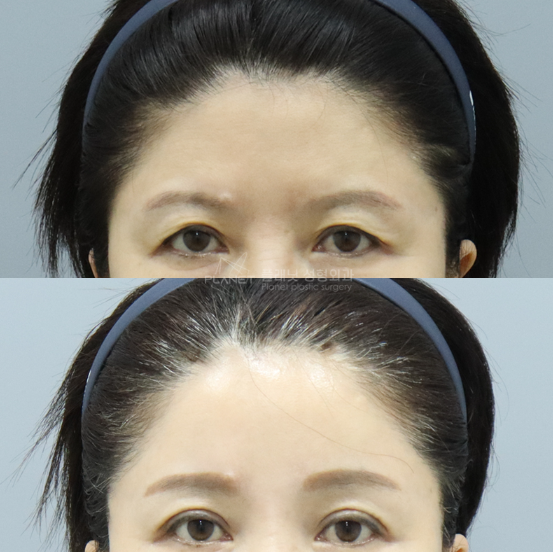
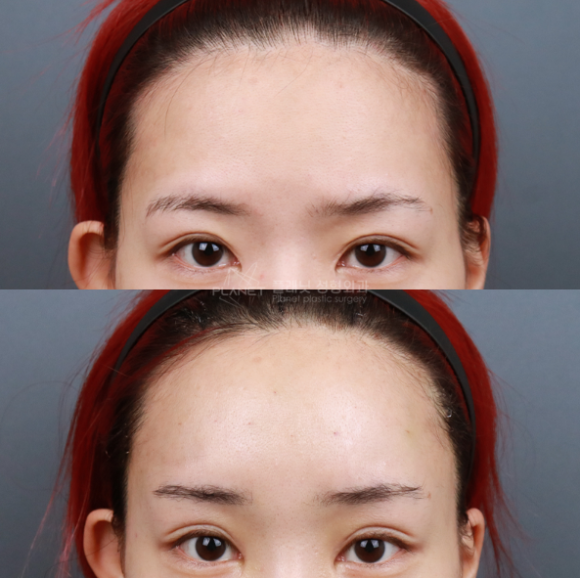
A brow lift rejuvenates this entire upper facial zone. By repositioning the brows to a youthful apex, it clears the hooding over your eyes, reveals your hidden double eyelid crease, and restores a bright, refreshed facial expression.
Crucially, these results do not come from simply pulling the skin tight. True longevity is dictated by how the underlying tissues are released and anchored.
Factor #1: The Number of Incision Points (3-Point vs. 5-Point)
To perform an endoscopic brow lift, a surgeon makes small incisions within the hairline, enters the subperiosteal plane, releases the bound tissues, and lifts them. One of the primary drivers of cost variation is how many incision points the surgeon utilizes.
[3-Point Incision] ──> Limited visibility; incomplete release of corrugator/temple muscles
[5-Point Incision] ──> Wide visual field; complete release of retaining anchoring muscles
- The 3-Point Approach (Low-Cost Option): Some clinics perform the surgery using only 2 to 3 incision points. While faster, this limited access restricts the surgeon’s visual field. It makes it extremely difficult to thoroughly release the two major anchoring muscles of the upper face: the temporalis muscle (at the temples) and the corrugator muscle (between the brows). If these muscles are not fully released, the lifting force is insufficient, and the brows quickly drop back down.
- The 5-Point Approach (Premium Option): Utilizing 5 strategic incision points provides a comprehensive, wide-angle endoscopic view. This allows the surgeon to safely and completely release the tight muscle anchors and secure the entire forehead evenly. This is why I perform every brow lift using a 5-point approach; it is technically more demanding, but it is the only way to ensure a symmetric, long-lasting result.
Factor #2: The Anchoring Technique (Endotine vs. Bone Tunneling)
Once the upper facial tissue is fully released and lifted, it must be anchored firmly to the skull to heal in its new position. The fixation method chosen directly impacts the surgical complexity, material costs, and final price.
1. Endotine Fixation (Device-Based)
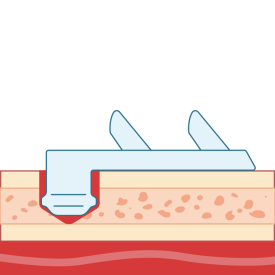
Endotine is a small, biodegradable plastic device with tiny tines that hook onto the lifted tissue. The surgeon drills a small hole in the skull and inserts the device.
- The Reality: It is a straightforward, faster method that many surgeons prefer. However, the device is relatively bulky. Depending on a patient’s unique skull shape and skin thickness, the Endotine device can sometimes be felt through the skin, causing temporary discomfort or localized hair loss until it fully dissolves (which takes about 6 to 12 months).
2. Bone Tunneling (Suture-Based)
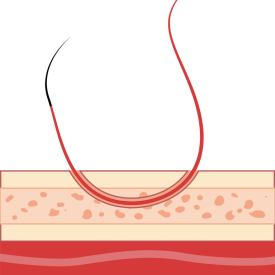
Bone tunneling is a master-level, highly demanding technique where the surgeon meticulously creates microscopic tunnels directly within the outer layer of the skull bone. High-strength, medical-grade sutures are then threaded through these tunnels to tie and secure the lifted tissue precisely in place.
- The Reality: This method requires exceptional manual dexterity and adds significant operating time. However, because it uses micro-sutures instead of a bulky plastic device, there is zero foreign body sensation, no risk of device-related hair loss, and the tissue is anchored with much higher customized precision across the forehead. This is the gold-standard method I trust and use for my patients.
At-a-Glance: Low-Cost Brow Lift vs. Premium Bone-Tunneling Lift
| Comparison Metric | Low-Cost Brow Lift | Planet’s Premium Brow Lift |
| Incision Points | 2 to 3 points | 5-Point Multi-Incision |
| Muscle Release | Partial or blind release | Complete release under clear endoscopic visualization |
| Fixation Method | Endotine device (Bulky, temporary) | Bone Tunneling (Suture-based, customized) |
| Foreign Body Sensation | Yes (Device can be felt under the skin) | None (Sutures are completely flat) |
| Longevity | Relapse common within 1–2 years | Stable, multi-year durability |
Conclusion: Ask About the Process, Not Just the Price
Cost is a completely valid and practical consideration when planning facial surgery. However, if price is the only variable you weigh, you risk choosing an under-corrected procedure that fails prematurely.
Before asking a clinic, “How much does it cost?” I highly encourage you to ask:
- “How many incision points do you use to release the corrugator muscle?”
- “Do you secure the lift using Endotine or bone tunneling?”
These two questions will tell you infinitely more about the safety, quality, and longevity of your future result than a simple price tag ever will.
If you have any questions about the endoscopic brow lift process, or if you would like to analyze your upper facial anatomy in detail, please leave a comment below or reach out to us directly at Planet Plastic Surgery Clinic.
Thank you for your time.
Written by Dr. Shin Dong-woo, Leading Surgeon at Planet Plastic Surgery Clinic.
FAQ
A. A 5-point lift requires more surgical time, advanced endoscopic equipment, and a higher level of precision. Utilizing 5 incisions allows the surgeon to completely visualize and release the strong muscle anchors (like the corrugator muscle) at the temples and between the brows. A 3-point lift is faster but limits access, often leading to incomplete muscle release and early lifting relapse.
A. Bone tunneling is a technique where microscopic tunnels are drilled into the outer skull bone, and sutures are threaded through to secure the lifted tissue. Unlike Endotine—which is a bulky, temporary plastic device that can sometimes be felt through the scalp or cause localized hair thinning—bone tunneling uses flat, medical-grade sutures. This eliminates any foreign body sensation, prevents hair loss, and provides a highly stable, customized anchor.
A. When performed utilizing a 5-point release and secure bone-tunneling fixation, the results of an endoscopic brow lift typically last between 7 to 10 years. The surgery resets your upper face to a much younger baseline, and while you will continue to age naturally, your eyebrows and eyelids will remain significantly more elevated than they would have without the procedure.
A. An unnatural, surprised look only occurs if the tissue is pulled straight upward under excessive tension without releasing the anchoring muscles. By utilizing a 5-point customized vector lift, we release the muscles first. This allows the forehead to lift naturally and smoothly under zero tension, restoring a relaxed, bright, and rested expression rather than a startled one.
A. Because the incisions are small and hidden entirely within the hairline, recovery is relatively swift. Minor swelling and bruising around the eyes and forehead peak within 3 to 5 days. Your sutures are removed at day 7 to 10, at which point any residual bruising can easily be camouflaged with makeup. Most patients comfortably return to work and social activities within 1 to 2 weeks post-surgery.