



A question came in through the comments recently that I’ve been thinking about since: “Doctor, can a full facelift also take care of the fat under my chin?”
I hear versions of it constantly in consultations. Can a double chin be fixed with this? Would device treatments be enough?
The honest answer is: it depends entirely on what’s causing yours. Below, I’ll explain the four underlying causes, walk through a recent case where three of them were present at once, and lay out how to tell which category you fall into.
The four causes of a double chin
The visible result looks similar from the outside, but the underlying problem — and therefore the right treatment — differs completely.
| Cause | What’s happening | What it responds to |
|---|---|---|
| Fat accumulation | Excess fat concentrated beneath the chin and along the neck | Liposuction, injectable fat reduction, some device treatments |
| Skin laxity | Skin has lost elasticity and descended with age | Surgical lifting; devices help only in mild cases |
| Platysma separation | The two neck muscle bands have drifted apart, blurring the jaw–neck boundary | Platysmaplasty (surgical repair) |
| Jaw structure | A small or recessed lower jaw creates the visual impression of fullness | Chin augmentation or orthognathic assessment |
Here is the point most people miss: a single isolated cause is the exception, not the rule. Most patients arrive with two or three factors compounding one another — which is exactly why a treatment aimed at one layer so often disappoints.
A case with three causes at once
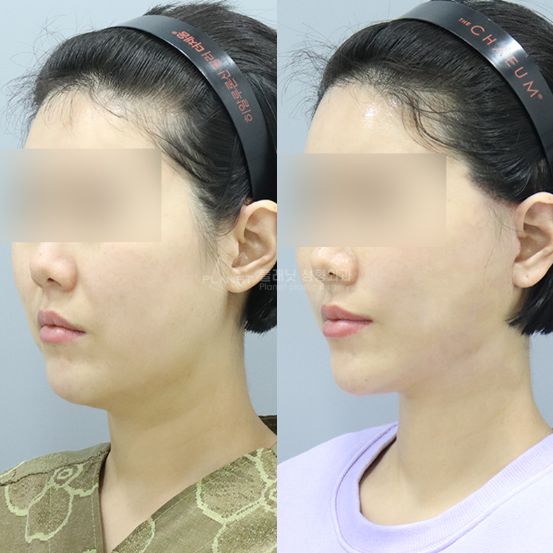
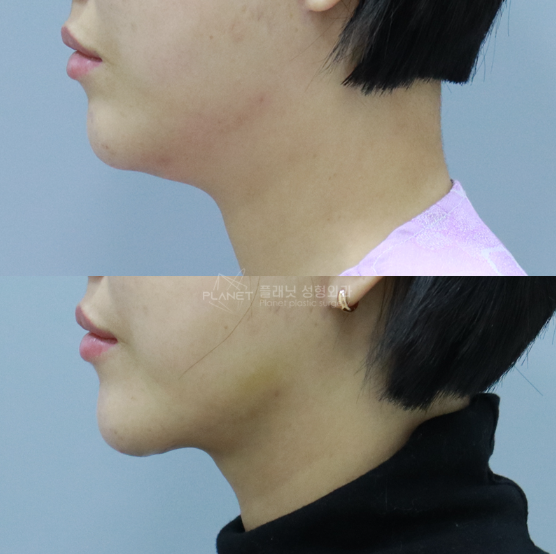
A patient I treated recently is a good illustration. She presented with:
- meaningful submental fat
- visible tissue descent from aging
- separated platysma bands
All three were working together to erase the boundary between her jaw and her neck. No single targeted treatment — no amount of fat reduction alone, no lifting alone — would have produced an acceptable result, because two thirds of the problem would have been left untouched.
Her goal, once we talked it through, wasn’t really “less thickness under the chin.” It was to rebuild the line of the lower face as a whole.
The surgical plan: three coordinated steps
1. Address the fat directly. The excess submental fat was visualized and removed in the appropriate amount, reducing the bulk weighing the lower face down.
2. Repair the muscle layer. The separated platysma bands were brought back together at the midline and sutured firmly, restoring the structural foundation that defines the jaw-to-neck transition.
3. Lift the skin and SMAS together. A full facelift repositioned the descended skin and the deeper supporting layer as a unit, so the newly refined jawline connected smoothly and naturally into the face above it.
The sequence matters. Removing fat without repairing the muscle can leave the neck looking hollow but still undefined. Lifting the skin without removing the fat simply relocates the heaviness.
“Wouldn’t the facelift alone handle it?”
This is the question I’m asked most often, and in a case like the one above, the answer is no.
A facelift repositions descended tissue in the face and upper neck. It does not remove fat that sits beneath the chin, and it does not close a gap between separated platysma bands. When all three factors are present, each has to be addressed directly and in coordination.
Where a facelift alone can be sufficient: when the fullness is primarily the result of descended tissue, with minimal excess fat and an intact muscle layer. That does happen — it’s simply less common than patients hope.
What about non-surgical treatments?
They have a genuine role, and I’d rather you understand it clearly than spend a year and a considerable amount of money finding out the hard way.
Device-based treatments and injectable fat reduction can produce real improvement when the problem is modest fat volume with good skin quality and no significant laxity — most often in patients in their 30s and 40s. They can also refine skin texture and provide mild tightening.
What they cannot do is remove a large fat volume, re-approximate separated muscle, or take up substantial skin excess. If you’ve already tried these treatments without the result you hoped for, that outcome is usually diagnostic in itself: it suggests the primary cause was never fat alone.
The same applies to weight loss. Submental fat is often relatively resistant, and weight loss can even worsen the appearance if it leaves behind skin that no longer retracts.
Recovery: a realistic timeline
Recovery varies with the extent of surgery and individual healing. As a general guide for a combined facelift, platysmaplasty, and submental fat removal:
| Stage | What to expect |
|---|---|
| Days 1–3 | Swelling and bruising peak; compression garment worn continuously |
| Days 7–10 | Sutures removed; bruising begins to fade |
| Weeks 2–3 | Comfortable in most ordinary social settings |
| Weeks 4–6 | Return to exercise, with a surgeon’s clearance |
| Months 3–6 | Residual swelling in the neck resolves; final contour settles |
Neck swelling typically takes longer to fully settle than the face. A degree of firmness or numbness under the chin for several months is normal and resolves.
Frequently asked questions
A small incision beneath the chin, hidden in the natural crease, plus the standard facelift incisions along the hairline and around the ear.
The removed fat cells do not return, and repaired platysma bands are secured. Significant weight gain or continued aging can still change the contour over time.
Yes — an isolated neck lift with platysmaplasty is appropriate when the face itself shows little descent. This is more common in younger patients.
It requires a physical examination: assessing skin retraction, palpating for fat versus muscle bands, and evaluating jaw projection. It’s not reliably determined from a photograph.
If you’re younger with good skin quality and modest fat, yes. If you already have visible laxity or muscle banding, you’ll likely be spending money to confirm what an examination would have told you.
The takeaway
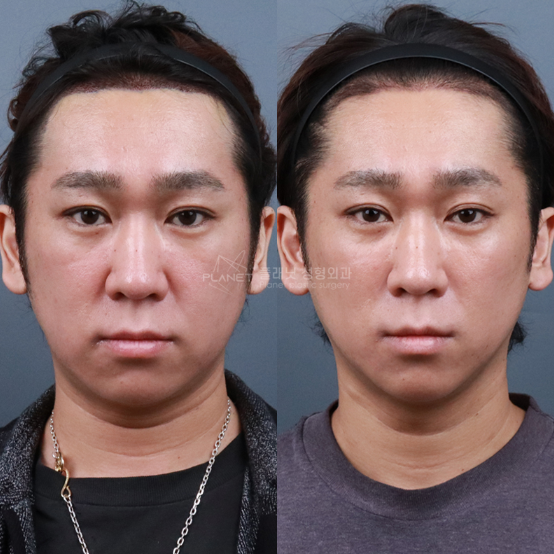
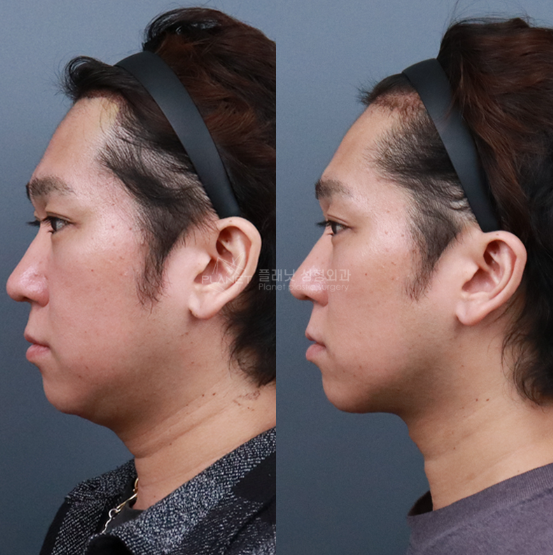
The single most important step in treating a double chin is correctly identifying what’s causing yours. Fat, skin, muscle, and bone each call for a different answer, and any treatment that addresses one while ignoring the others will deliver an incomplete result.
If weight loss and device treatments haven’t given you what you hoped for, the most useful next step is a diagnostic consultation — not to commit to surgery, but simply to find out what you’re actually dealing with and what your realistic options are.
Thank you for reading to the end. Take care of yourselves in this warm weather.
Ready to find out which type you are? A consultation includes a physical assessment of the fat, skin, and muscle layers, and an honest conversation about whether surgery — or something less invasive, or nothing at all for now — is the right step. [Book a consultation →]
Dr. Shin Dong-woo is a plastic surgeon at Planet Plastic Surgery Clinic, specializing in facial contouring, facelift, and neck lift surgery.
This article is for general information and does not constitute medical advice. Outcomes vary between individuals, and every surgical procedure carries risks and possible complications, which should be discussed in person with a qualified surgeon.