



Hello, I am Dr. Shin Dong-woo, leading plastic surgeon at Planet Plastic Surgery Clinic.
For patients who feel that non-surgical laser treatments haven’t delivered enough results, but find a full facelift too daunting—physically or psychologically—the mini facelift is often the procedure they gravitate toward first.
When considering a mini facelift, most people spend hours studying before-and-after photos. This is a natural and completely logical step. However, there is a critical problem: most patients unknowingly skip past the specific details that actually matter most when analyzing these images.
Before-and-after photos are a helpful reference, but if you do not know what to look for, there is a high risk that what you see in someone else’s photo won’t match your real-world result.
Today, I would like to share 4 specific checkpoints every patient should apply when evaluating mini facelift before-and-after photos.
📌 Key Takeaways (Photo Evaluation Summary)
- Extent of Improvement: Look for comprehensive lifting across the cheek, jawline, and mouth—not just a slight tightness around the ears.
- Photo Timing Matters: Results at 2 weeks post-op reflect swelling. Insist on seeing 6-month to 1-year follow-up photos to verify longevity.
- Watch for Complications: Check side profile shots for pixie ear deformities, cheek dimpling, unnatural skin pulling, and visible ear scars.
- Hidden Revision Risks: Mini facelifts leave internal SMAS scar adhesions that make future full facelifts significantly more complex.
1. Is the Degree of Facial Change Actually Meaningful?
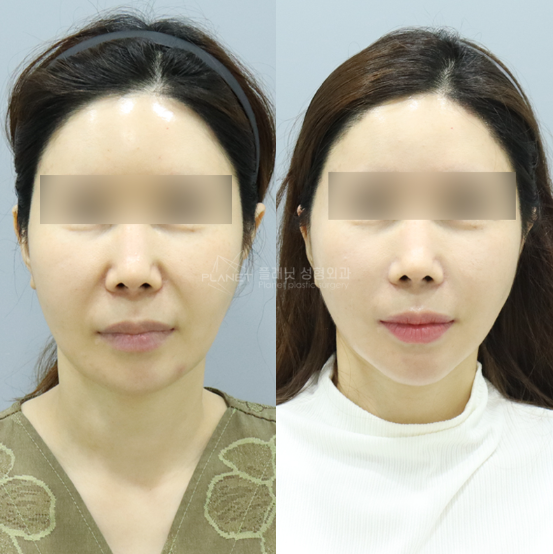
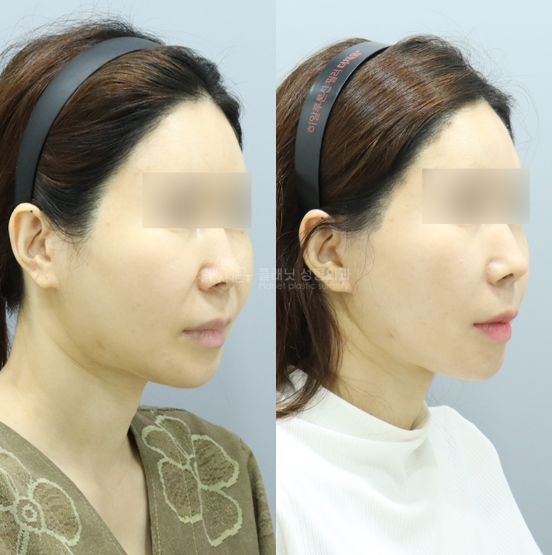
The first and most fundamental element to evaluate is the sheer extent of structural improvement.
A subtle tidying of the skin outline is simply not enough. True facial rejuvenation requires comprehensive improvement—addressing the nasolabial folds, the marionette lines around the mouth, and the sagging jawline simultaneously, so the entire face looks naturally refreshed rather than artificially pulled in one specific spot.
Keep in mind that a mini facelift relies on a shorter incision and more restricted dissection than a traditional facelift. Because the surgical access is narrow, its capacity for physical repositioning is inherently constrained.
When looking at before-and-after photos, don’t just notice that “some lifting happened.” Ask yourself: Which exact areas improved? By how much? Does the visible outcome justify the financial investment, surgical recovery, and effort involved?
2. How Much Time Has Passed Since the Surgery?
Judging surgical success solely from photos taken days or weeks after the procedure is another common and misleading trap.
In the early post-operative period, residual internal swelling and temporary skin tightness create the illusion of a smooth, dramatically lifted face. However, what you see during early recovery is rarely what remains after healing is complete.
I strongly encourage patients to look specifically for long-term follow-up photos—ideally taken at least 6 months to 1 year post-surgery.
In my consultation room, I frequently evaluate patients who were thrilled with their mini facelift results immediately after surgery at another clinic, but come to see me a year later because the sagging has fully returned. Because limited dissection scope can compromise longevity, paying close attention to when the photos were taken is essential.
3. Are There Hidden Signs of Surgical Complications?
When reviewing before-and-after photos, do not just search for what improved—look carefully for subtle indicators of surgical complications.
Because a mini facelift attempts to achieve lifting force through a narrow incision near the ear, tension can concentrate unevenly. Common flaws to watch out for include:
- Pixie Ear Deformity: Where the earlobe is pulled downward and attached unnaturally to the cheek tissue.
- Cheek Dimpling/Sunken Areas: Caused by uneven vector pulling across the midface.
- Visible Incision Scars: Thickened or widened linear scars in front of the tragus due to excessive skin tension.
- Facial Asymmetry: Uneven lifting between the left and right sides.
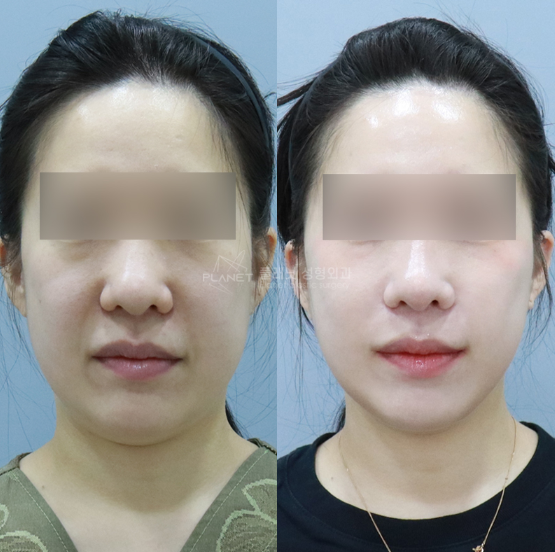
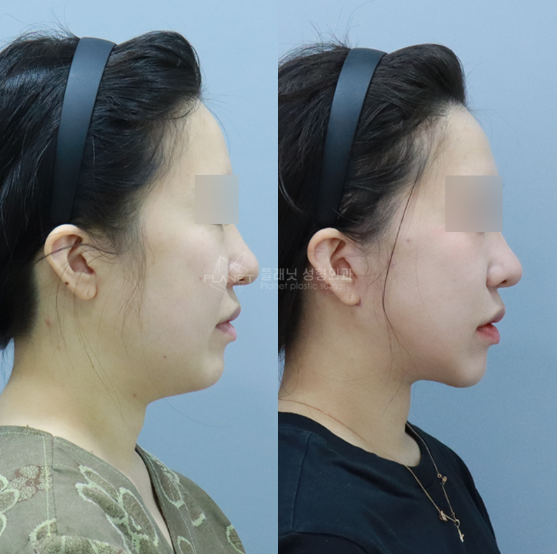
Most marketing photos show only straightforward front-facing angles where ear scars and unnatural cheek contours are hidden. Always look for multi-angle shots—including 45-degree and 90-degree side profiles—to inspect whether the earlobe retains its natural shape and whether the incision scar blends seamlessly into the ear’s natural cartilage.
4. The Unseen Factor: Future Revision Surgery Risk
There is one critical factor that no before-and-after photo or written testimonial can ever show you: What happens if you need revision surgery down the road?
Even though a mini facelift uses a smaller incision, it is still an invasive surgical procedure. The sub-dermal and SMAS layers are dissected, and as the tissue heals, internal scarring and fibrotic adhesions form beneath the skin.
If a full facelift becomes necessary later in life—which is common given the limited longevity of standard mini lifts—operating through that pre-existing scar tissue is substantially more complex. Releasing internal adhesions requires extra time, increases bleeding risks, and restricts incision placement.
At Planet Plastic Surgery Clinic, we recognized these limitations early on. To overcome the short longevity and limited vector pull of standard mini lifts, we developed specialized techniques like the Mini-Plus Lift and Plus-Up Lift. By extending the incision and SMAS dissection scope in a controlled manner, we provide patients with more durable, natural contours.
Conclusion: Use Photos as a Guide, Not a Guarantee
Before-and-after photos are valuable tools, but they should be evaluated with a trained, objective eye. Always look beyond immediate skin smoothness and examine long-term results, scar quality, earlobe naturalness, and full-face harmony.
The ultimate choice of procedure should not rely on photo galleries alone, but on an accurate clinical diagnosis of your unique facial structure, skin thickness, and long-term aging goals.
Thank you for reading today’s guide.
Dr. Shin Dong-woo Leading Surgeon, Planet Plastic Surgery Clinic
FAQ
A1. Early post-operative photos capture temporary tissue swelling and acute skin tightness. If the deep SMAS layer was not properly released and anchored during the mini lift, skin elasticity will cause the tissue to stretch back within 6 to 12 months once swelling resolves.
A2. A pixie ear occurs when excessive tension is placed on the skin around the earlobe during closure. This pulls the earlobe downward, giving it an elongated, stuck-to-the-cheek appearance instead of a naturally rounded shape.
A3. Indirectly, yes. If a photo shows significant improvement in the lower face and jawline without skin tightness around the mouth or ear distortions, deep SMAS anchoring was likely performed. Skin-only lifts typically produce flat, pulled-back cheeks rather than natural upward volume.
A4. The most reliable photos are taken between 6 months and 1 year post-surgery. By this time, internal surgical swelling has completely subsided, scar maturation is underway, and the settled, long-term outcome can be accurately judged.
A5. Yes, a full facelift is possible after a mini facelift, but it requires an experienced facelift specialist. The previous surgery leaves internal scar tissue and tissue adhesions under the skin, making SMAS dissection more intricate and time-consuming.