



If you’ve researched facelift surgery in any depth, you’ve probably come across the term pixie ear.
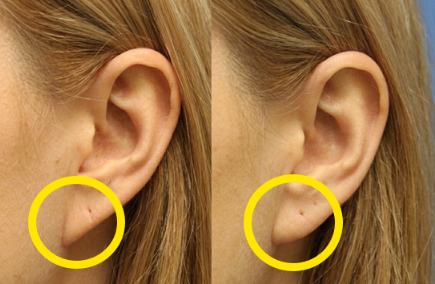
It refers to a specific outcome: the earlobe loses its soft, rounded lower edge and is instead pulled downward, elongated, and blended flush into the cheek — pointed at the tip rather than curved away from the face.
It’s one of the concerns patients raise most often before surgery, and reasonably so. Below: why it happens, how it’s planned against, how to tell whether what you’re seeing is actually pixie ear, and what correction involves.
What pixie ear actually is
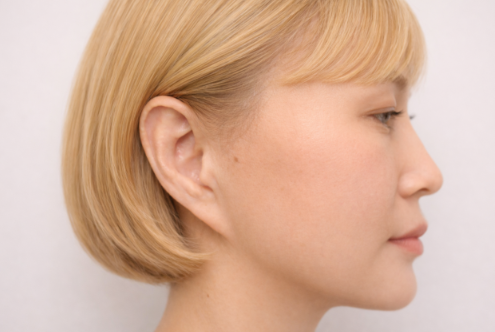
In its natural state, the earlobe has a gently rounded lower edge that curves smoothly away from the cheek — what surgeons sometimes call a free earlobe.
In a pixie ear deformity, that curve is lost. The lower edge stretches downward along the cheek, becoming elongated and pointed, and the junction between earlobe and cheek disappears.
Important: this cannot be diagnosed early. Some distortion of the ear in the first weeks after surgery is expected, caused by swelling and temporary skin tension. What matters is how the tissue settles as healing progresses — generally assessed at six to twelve months, once swelling has fully resolved and scar tissue has matured. Judging the ear at three weeks tells you very little.
The three causes
1. Excessive tension in the skin layer
A facelift lifts descended tissue and secures it, and tension is inherent to that. The question is which layer carries it.
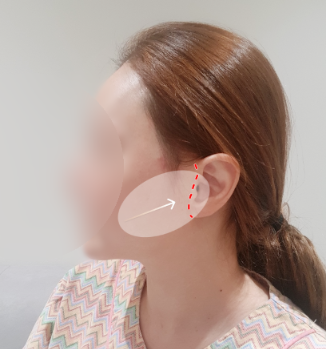
When the lifting force is applied primarily to the outer skin rather than distributed through the deeper SMAS layer, that tension transmits directly to the tissue around the ear. The earlobe is pulled downward and elongated, and the rounded curve is lost. This is the most common mechanism.
2. Earlobe position set incorrectly at closure
Skin and soft tissue settle downward as healing progresses. If the earlobe is sutured to match where it sits immediately after surgery, it will descend along with everything else over the following months and gradually assume the pixie shape.
The error here is not one of technique in the moment — it’s one of failing to plan for what happens afterward.
3. Individual skin elasticity
People differ considerably in skin extensibility. Patients with particularly soft, highly elastic skin are more prone to downward earlobe migration during healing even when the technique itself is sound.
This is worth stating plainly: this third factor is the reason pixie ear can be made unlikely but not made impossible. Any surgeon who promises a zero percent rate is overstating what surgery can control.
How it’s prevented
Two variables, both decided during surgery.
Earlobe position — planned forward in time. When deciding where to place the earlobe at closure, the reference point should be where it will sit once healing is complete, not where it sits on the table. Immediately after the lift, the tissue is elevated and the earlobe sits higher than its eventual resting position. Because the earlobe is a small structure, even a minor positional error compromises the curve. For this reason I deliberately set the fixation point slightly higher than the anticipated final position, building the expected settling in from the start.
Tension routed through the SMAS. If the skin carries the load, the ear pays for it. Lifting and securely fixing the SMAS layer as the primary anchor shifts the mechanical burden to the deep layer, which substantially reduces tension on the overlying skin and protects the earlobe from the distorting pull. This is the same principle that keeps the overall result from looking tight or pulled — the ear is simply where a failure of that principle shows up first.
Questions worth asking before surgery
If this is a concern for you, these are reasonable things to raise in a consultation:
- Will the lift be anchored at the SMAS layer, or primarily at the skin?
- How is the earlobe position determined at closure — and is settling accounted for?
- Can I see results photographed at six months or later, with the ears visible?
- My skin is quite soft and elastic — does that change your plan for me?
- If pixie ear did develop, how would you approach correcting it?
A surgeon who welcomes these questions is giving you useful information either way.
If pixie ear has already developed
It is correctable, but the plan has to start from an accurate diagnosis of the cause rather than from the appearance alone.
Mild distortion. Releasing the adhesion around the earlobe and repositioning it may be enough to restore a natural curve. This is often a limited procedure under local anesthesia, with a short recovery.
Distortion caused by skin-layer tension. Loosening the surface skin is not sufficient here, because the underlying force that created the problem is still present — release the skin alone and it will recur. The support structure needs to be redesigned so tension is carried by the SMAS, and the earlobe position re-established from that foundation. This is a more substantial procedure, closer in scope to a revision facelift.
Timing. Correction is generally deferred until scar tissue has matured, typically at least six to twelve months after the original surgery. Operating into actively remodeling tissue makes the result less predictable.
Frequently asked questions
Not before six months, and often not confidently before a year. Early elongation frequently resolves as swelling settles.
It can progress during the first several months as tissue settles, then stabilizes. Continued worsening after a year is unusual and warrants assessment.
Often yes, when the distortion is mild and localized. When excessive skin tension is the cause, a more complete correction is usually necessary for the result to hold.
The existing incision line around the earlobe is generally re-used, so additional scars are usually avoided.
It is more associated with skin-only lifting, where the skin bears the tension, than with techniques that anchor at the deep layer.
The takeaway
Pixie ear is largely, though not entirely, preventable — and prevention happens during the operation, in decisions about where tension is anchored and where the earlobe is positioned relative to where it will settle.
If you’re weighing surgery and this is on your mind, the productive place to address it is a consultation beforehand, where your skin quality can be assessed and the plan discussed directly. If it has already happened, correction is realistic once the timing is right.
Thank you for reading to the end.
Have a concern you want assessed? A consultation includes an evaluation of skin elasticity and the specific factors relevant to your case, along with a direct explanation of how the surgical plan accounts for them. [Book a consultation →]
Dr. Shin Dong-woo is a plastic surgeon at Planet Plastic Surgery Clinic, specializing in facelift, revision facelift, and facial contouring surgery.
This article is for general information and does not constitute medical advice. All surgery carries risks and possible complications, individual outcomes vary, and suitability can only be determined through in-person examination by a qualified surgeon.