



A patient came in a few weeks ago with a page of notes. She’d written down four technique names and wanted to know which one I performed.
I understood the impulse completely — she was trying to turn an impossible decision into a checkable list. But I had to tell her something she didn’t want to hear: the names on her page were not going to tell her what she was trying to find out.
Let me explain why, and then explain what does.
“We work with the SMAS” no longer distinguishes anyone
If you’ve researched facelifts at all, you’ve met the term SMAS facelift, and probably absorbed the idea that a real facelift has to reach the SMAS layer.
That’s true as far as it goes. It’s also, at this point, close to meaningless as a differentiator. Essentially every clinic performing facelift surgery today engages the SMAS in some form. Asking “do you address the SMAS?” is a bit like asking a restaurant whether they cook the food.
The question that still has information in it is how: how the dissection is carried out, in which direction the tissue is moved, and where it’s anchored.
The anatomy, briefly
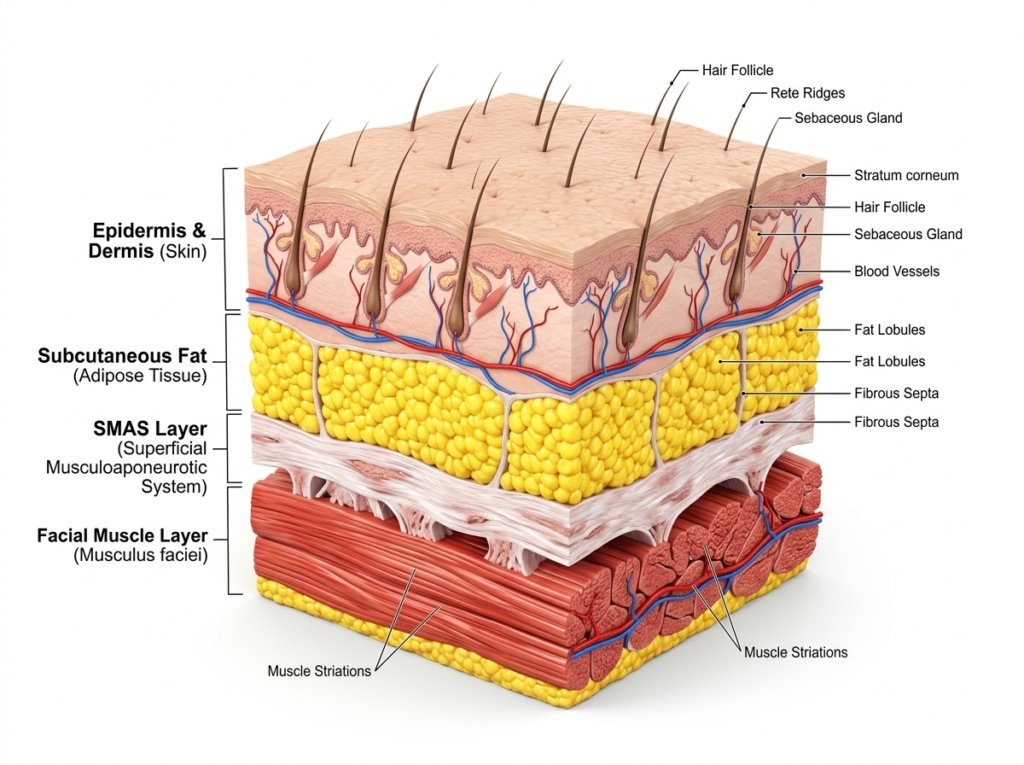
The face is stacked:
Skin → subcutaneous fat → SMAS → deeper muscle and tissue → bone
The SMAS is a thin fibromuscular sheet sitting beneath the fat, supporting the face as a whole. With age it isn’t only the skin that descends — the SMAS descends too, and because the skin is connected to it, pulling the skin alone produces surface tightening over an unchanged structure. That’s why a skin-only result relaxes so quickly.
A facelift, properly understood, isn’t a skin-pulling operation. It’s the separation of the descended SMAS from surrounding tissue and its repositioning back toward where it originally sat. The skin follows as a secondary step: only the excess created by that underlying movement is trimmed, and it isn’t put under independent tension.
That principle is the accepted foundation of modern facelift surgery. The techniques diverge within it.
Deep plane and dual plane
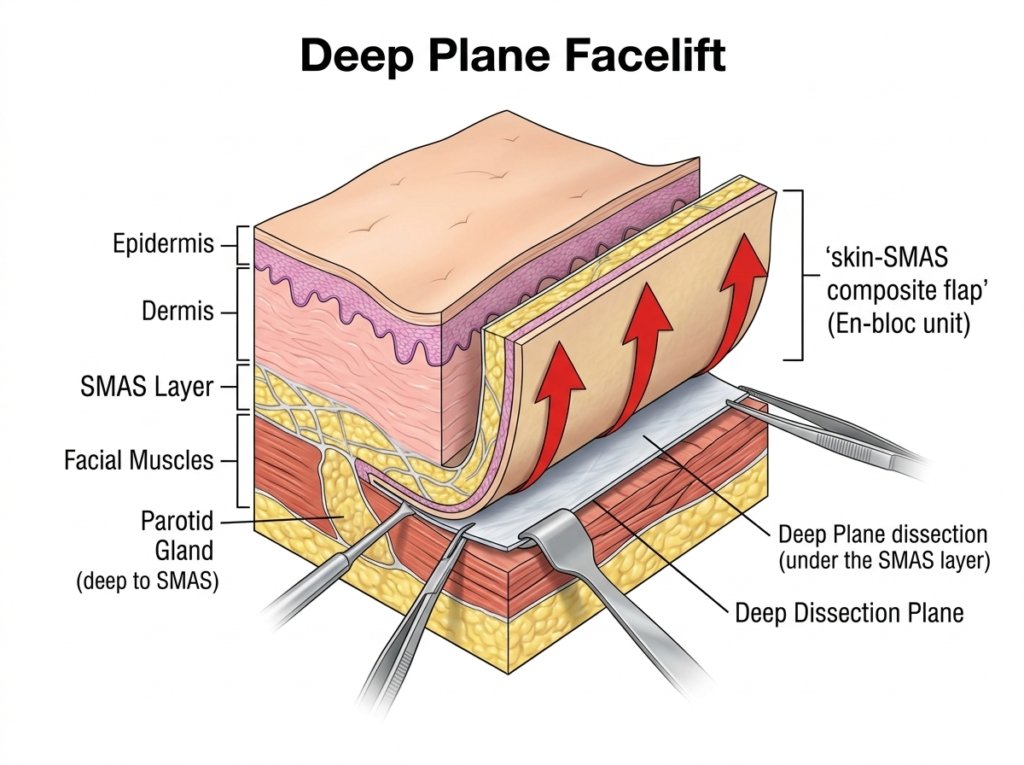
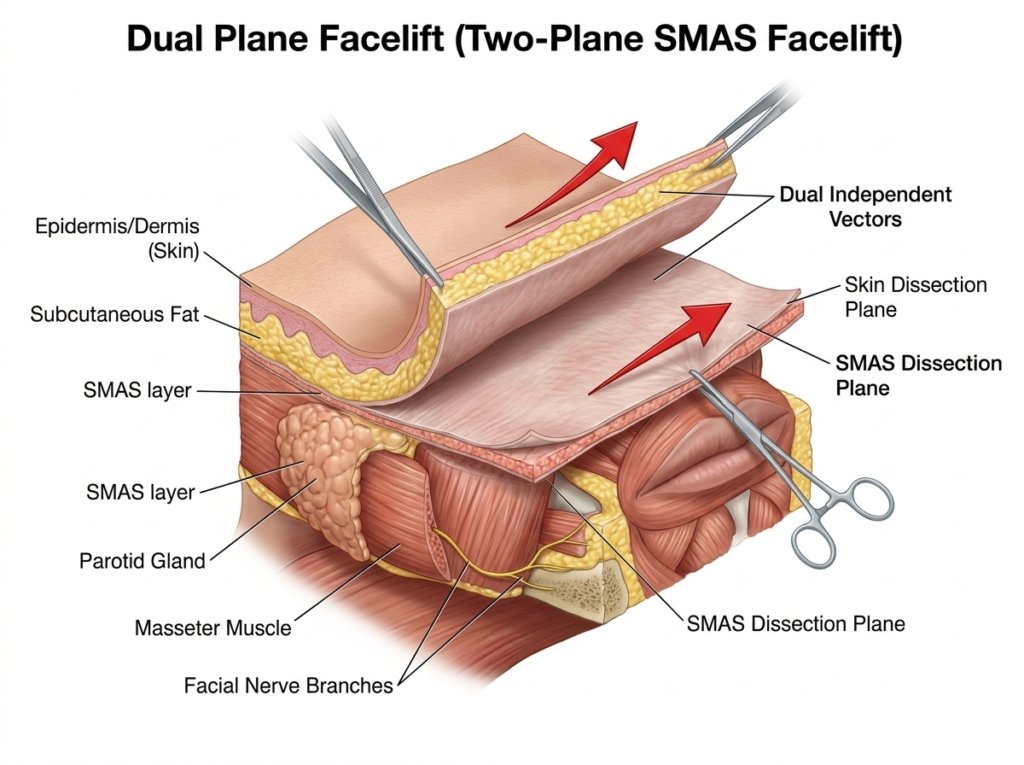
| Deep plane | Dual plane | |
|---|---|---|
| Skin and SMAS | Moved together as one composite unit | Separated, then dissected and lifted independently |
| Lifting vector | One consistent direction for both layers | Different angle and tension for each layer |
| Strength of lift | Strong; force applied to the composite flap | Strong, with more granular control |
| Directional planning | Comparatively straightforward | More variables to manage |
| Suits | Patterns where a uniform vector fits the anatomy | Prominent cheekbones, marked deep cheek descent, asymmetric or complex descent patterns |
| Trade-off | Less ability to differentiate by region | More dissection, more room for technical error |
The dual plane advantage is specifically the independence: the skin might be lifted more vertically while the fascia is lifted on a diagonal, with tension calibrated separately for each. Where a single uniform vector would produce something that looks pulled in one region and undercorrected in another, that separation is genuinely useful.
Neither is categorically superior. I want to be firm about this, because the marketing in this field pushes hard in the opposite direction. What matters is the match between technique and patient — bone structure, skin thickness, and the depth and pattern of descent.
A caution about the words themselves
Here’s something I don’t see written down often enough, and it happens to reinforce everything above.
These terms are not standardized. Deep plane has a reasonably consistent meaning in the surgical literature; dual plane is used differently by different surgeons and different clinics, and in some contexts refers to an entirely different operation altogether. Two surgeons can use the same word for different dissections, and different words for the same one.
Which means: if you compare two clinics by the technique names on their websites, you are comparing marketing vocabulary, not surgery. The only reliable way through this is to ask the surgeon to describe, in plain language, what plane they will dissect in and where they will fix the tissue — and to notice whether they can.
Where the result actually lives
Beyond the choice of technique, four things carry more weight in my experience:
Dissection depth, and its consistency. I aim to dissect directly along the plane just above the SMAS, holding as uniform a depth as I can throughout. Consistency here helps preserve blood supply to the overlying skin, which is what a smooth surface result depends on.
Handling of the retaining ligaments. These anchor soft tissue to the periosteum. Until they’re selectively released, descended tissue can’t reach where it needs to go, regardless of how well the SMAS itself is managed — and this is also where the facial nerve branches run closest. It’s a large enough topic that I’ve written about it separately.
The lifting vector. Where the tissue is directed, matched to the individual pattern of descent rather than to a default.
Tension distribution. Where the load sits. If it ends up in the skin, that’s where the problems appear — visible scarring, a drawn appearance, and distortion around the ear.
Where dual plane can go wrong
Since I’ve described its advantages, I should describe its risks honestly.
When time pressure pushes a surgeon to dissect primarily through the middle layer without carefully accounting for the thickness and position of the subcutaneous fat above it, the vessels running within that fat layer are at increased risk. And when dissection depth wanders — particularly when it strays too close to the underside of the skin — the risks of skin injury and surface irregularity rise.
The extra control dual plane offers is bought with extra dissection, and extra dissection is extra opportunity for error. That trade is worth making when the anatomy calls for it and not otherwise.
I also address bleeding points as they arise rather than leaving them to settle. Meticulous hemostasis takes time and shows up nowhere in a photograph, but uncontrolled bleeding prolongs bruising and swelling, and I’d rather spend the minutes during the operation than have the patient spend the weeks afterward.
Better questions than “do you do SMAS?”
- What plane will you dissect in, and how do you keep the depth consistent?
- Will the skin and fascia be lifted in the same direction, or separately?
- How will you set the lifting vector for my particular pattern of descent?
- Will the retaining ligaments be released, and which ones?
- Where will the tension sit when you’re finished?
- Why this technique for me rather than the alternative?
The last one matters most. A surgeon who can explain why your anatomy led them to a particular approach is telling you something real. A surgeon who performs the same operation on everyone will struggle to answer it.
Frequently asked questions
They aren’t opposites. Deep plane is a way of working with the SMAS — specifically, dissecting beneath it and moving skin and SMAS as one unit.
Longevity depends more on adequate ligament release, vector, and fixation than on the technique label. A well-executed procedure of either type should hold for years.
It involves more dissection, which means more scope for technical error. In appropriate hands and appropriate anatomy, that trade is reasonable.
I’d pick the one that can explain why that technique suits your face specifically. Advanced-sounding is not the same as suitable.
The operative note should describe the plane of dissection and the fixation. That’s more informative than the procedure’s marketing name.
The takeaway
“SMAS facelift” describes almost nothing about what will actually happen in the operating room. Deep plane versus dual plane narrows it a little. Dissection depth, ligament release, lifting vector, and tension distribution narrow it a great deal.
So I’d gently suggest putting down the list of technique names — and asking instead why a particular surgeon has chosen a particular approach for your face. The quality of that answer tells you more than any term on it.
Thank you for reading to the end.
Want to know which approach fits your anatomy? A consultation includes an assessment of skin thickness, bone structure, and the pattern of descent, with a direct explanation of which technique that leads to and why.
Dr. Shin Dong-woo is a plastic surgeon at Planet Plastic Surgery Clinic, specializing in facelift, revision facelift, and facial contouring surgery.
This article is for general information and does not constitute medical advice. Technique terminology varies between surgeons and institutions. All surgery carries risks and possible complications, and suitability can only be determined through in-person examination by a qualified surgeon.