



Hello, I’m Dr. Shin Dong-woo, the leading surgeon at Planet Plastic Surgery Clinic.
Thread lifting has experienced an incredible surge in popularity over recent years. In fact, a vast majority of the patients who visit my consultation room have already undergone a thread lift at least once or twice before seeking my advice.
The appeal of threads is completely understandable: they offer much more immediate, visible lifting results than energy-based lasers, but without the extensive downtime or physical demands of surgery. It is easy to see why so many individuals gravitate toward it.
However, what remains unclear to most patients is exactly how threads function anatomically—and how much they can realistically achieve.
Today, I want to provide an honest, straightforward analysis of the core principles behind thread lifting—its genuine strengths, its real structural limitations, and how it directly compares to surgical facial rejuvenation.
What is a Thread Lift, and How Does It Function?
A thread lift involves inserting specially engineered, biocompatible, and dissolvable sutures equipped with microscopic barbs beneath the skin. These barbs catch onto the loose subcutaneous tissue, allowing the surgeon to physically pull and anchor the sagged tissue upward.
📌 The Real Advantages:
- Zero Incisions: Performed via tiny needle puncture entry points that leave no surgical scars.
- Rapid Recovery: Minimal downtime, allowing a swift return to daily life within a few days.
- Collagen Stimulation: As the threads naturally dissolve, they trigger a localized healing response that stimulates new collagen production, improving skin thickness and texture.
⚠️ The Critical Anatomical Boundary:
For patients experiencing early-stage tissue laxity, thread lifting is an exceptional option. However, it is vital to realize that thread lifting is, at its core, a temporary relocation of soft tissue.
As we cross into advanced structural aging, it is not just the skin surface that drops. The deep SMAS framework (the muscular envelope), the supporting retaining ligaments, and the deep fat compartments all slide downward together under gravity. Sutures placed in the superficial fat layers simply do not possess the mechanical holding power to lift a collapsed deep musculoskeletal framework.
This is a recurring pattern in my clinic: patients arrive deeply frustrated after multiple rounds of thread lifts, reporting that each subsequent procedure yielded smaller results that faded faster than the last. The issue isn’t that thread lifting failed; it’s that threads were the wrong tool for a deep, structural problem.
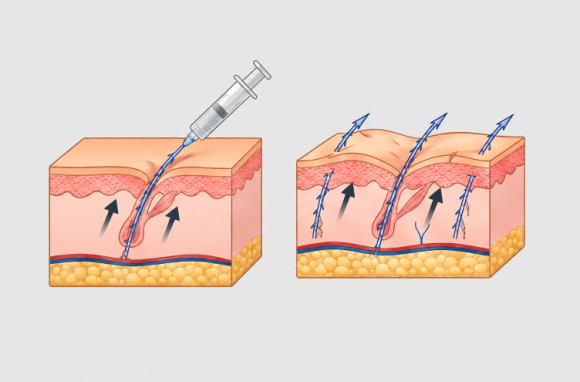
When Threads Aren’t Enough: Shifting to a Facelift
If you are currently experiencing pronounced jowling, severe hollowing of the midface, or loose skin cascading into the neck, threads will hit a strict clinical ceiling.
In these advanced scenarios, a surgical Facelift (Rhytidectomy) is the medically appropriate solution.
[Thread Lift]  ──> Relocates superficial fat pockets temporarily (No skin excision)
[SMAS Facelift] ──> Releases ligaments, vertically shifts the deep muscle framework, and excises excess skin
A facelift does not merely pull the skin taut. It penetrates to the foundation, releasing the bound retaining ligaments, resetting the dropped SMAS framework vertically backward, and excising the hanging, excess skin. Because it targets the root structural failure, the outcome is fundamentally different in both aesthetic depth and durability, typically lasting 10 to 15 years.
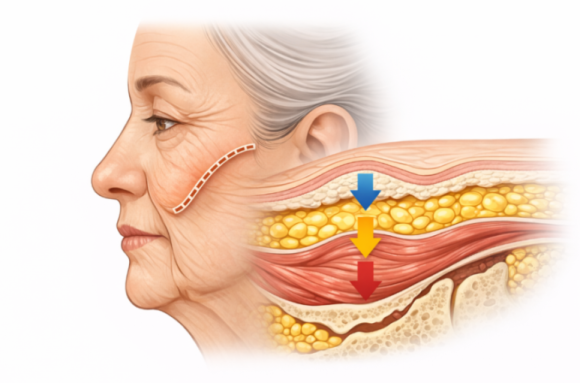
The Hidden Warning: Why Repeated Thread Lifts Complexify Future Surgery
If you suspect that a surgical facelift may be in your future roadmap, I strongly advise against undergoing repetitive, temporary thread lifts in the meantime.
Every round of inserted threads generates an internal inflammatory response, causing the surrounding tissues to scar, harden, and form dense fibrotic adhesions. Furthermore, fragments of older, non-dissolved threads frequently remain embedded and tangled within the delicate fascial layers.
Inside the operating room, these remnants present severe obstacles:
- Obliterated Planes: A facelift requires a surgeon to smoothly separate distinct, delicate anatomical layers. Scar tissue from previous threads glues these layers together, making dissection highly treacherous.
- Nerve Preservation Risks: Delicately separating facial nerves from dense, thread-induced scar tissue requires meticulous, slow-paced maneuvering, significantly extending the operating time.
- Compromised Smoothness: Severe internal fibrosis can occasionally restrict the uniform, smooth re-draping of the skin, impacting the pristine quality of the final surgical result.
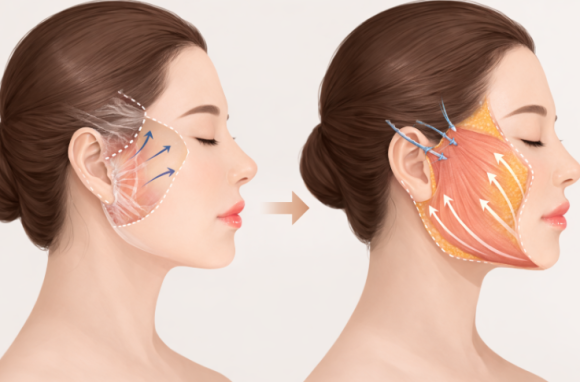
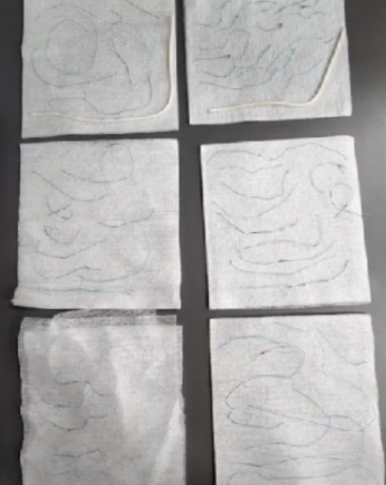
At-a-Glance: Thread Lift vs. Surgical Facelift
| Comparison Metric | Thread Lifting (Non-Surgical) | SMAS Facelift (Surgical Rejuvenation) |
| Anatomical Target | Superficial subcutaneous fat layer | Deep SMAS muscle layer & retaining ligaments |
| Excess Skin Removal | None (Skin is bunched, not removed) | Yes (Loose, stretched skin is cleanly excised) |
| Internal Tissue Impact | Creates localized temporary scar columns | Releases deep structural bounds for permanent reset |
| Result Longevity | Short-term (Approx. 6 months to 1 year) | Long-term & Stable (Typically 10–15 years) |
| Future Surgical Impact | Multiple rounds create dense internal adhesions | Resets the aging clock to a much younger baseline |
Conclusion: Listen to Your Face
Thread lifting is far from a meaningless procedure—for the right patient at the early stage of aging, it delivers highly satisfying, efficient rejuvenation.
But if you have begun to notice that your thread lift results are fading within a matter of months, or if you are hesitating before booking another round, that hesitation is a clear signal from your anatomy. Your facial aging has likely transitioned from a surface-level volume shift to a deep structural descent.
Rather than continuing a cycle of temporary fixes that may complicate your future choices, it is wisest to seek an honest, anatomical diagnosis.
If you are ready to evaluate whether your face requires superficial suspension or a fundamental structural lift, please leave a comment below or connect with us directly at Planet Plastic Surgery Clinic to map out your safe, long-term anti-aging roadmap.
Thank you for reading.
Written by Dr. Shin Dong-woo, Leading Surgeon at Planet Plastic Surgery Clinic.
FAQ
A. When you first experience mild aging, threads easily capture and hold the lightweight tissue. However, as aging advances, the heavy SMAS muscle layer and deep fat compartments completely slide downward. Furthermore, repeated thread lifts create uneven internal scar tissue and lose structural traction. Threads cannot excise the resulting excess skin or lift deep muscles, causing subsequent procedures to fail or relapse rapidly.
A. A premium facelift requires the surgeon to navigate smoothly through distinct, clean tissue planes to safely lift the deep SMAS layer and protect facial nerves. Multiple prior thread lifts leave behind dense fibrotic adhesions and thread remnants that glue these delicate layers together. Dissecting through this tough scar tissue requires extreme surgical caution and significantly increases operating time to ensure no tissue or nerve damage occurs.
A. It is highly recommended to wait at least 3 to 6 months after your last thread lift before transitioning to a surgical facelift. This allows any temporary swelling or active internal inflammation to fully subside and gives the dissolvable thread materials time to soften or break down, making the internal environment safer and more predictable for deep surgical dissection.
A. Yes. Skin puckering or dimpling happens when a thread lift barb is anchored too close to the superficial skin surface under uneven tension. During a surgical facelift, we enter a deeper plane beneath the SMAS layer, completely release the misplaced threads and underlying scarred anchor points, re-drape the outer skin smoothly under zero tension, and excise the true excess tissue to permanently eliminate the dimpled texture.
A. No, they are rarely performed concurrently in the same area because they serve contradictory mechanical purposes. A facelift provides a comprehensive, permanent, deep-layer vertical repositioning with structural skin removal, making a superficial thread lift in that same zone entirely redundant. However, a thread lift can occasionally be used to treat mild, isolated laxity in a separate, non-surgical zone if a patient is undergoing a highly targeted mini-lift.