



Booking a facelift abroad is nothing like booking a vacation. You aren’t picking a hotel and a flight. You’re picking a surgeon, an operating facility, a recovery environment, and a medical team that may be thousands of miles from your home.
That’s why preparation matters so much for anyone researching a face lift in Korea.
Seoul has become one of the best-known destinations in the world for plastic surgery, and if you’ve spent any time searching, you’ve probably run into a whole vocabulary: Korean facelift, deep plane facelift, SMAS facelift, mini facelift, neck lift, facial lifting in Seoul. The list goes on.
But the decision shouldn’t start with trends or social media photos. A facelift is a major operation on the deeper structures of the face, and the questions that really matter are far more practical:
- Who is performing the surgery?
- Which technique actually suits your anatomy?
- How long should you stay in Korea?
- What happens if a problem develops after you fly home?
- How will follow-up work from a distance?
- What exactly is included in the quote?
This guide walks through each of those questions so you can make a decision you’ll still feel good about a year from now.
Why Do International Patients Choose Korea for Facelift Surgery?

Korea has built a large aesthetic medicine sector, concentrated heavily in Seoul. For a visiting patient, one obvious advantage is density: many clinics offering facial procedures sit within a few compact neighborhoods, which makes consultations with more than one surgeon realistic in a single trip.
The other draw is the range of techniques on offer. Depending on the clinic, you may see procedures described as:
- Deep plane facelift
- SMAS facelift
- Mini facelift
- Full facelift
- Face and neck lift
- Neck lift
- Revision facelift
- Forehead lift
- Facelift combined with fat grafting
- Facelift combined with eyelid surgery
Here’s the catch: more options don’t make the choice easier. They often make it more confusing. Two clinics may use different names for nearly identical operations, while two operations with the same name may be done quite differently.
So look past the label. The question that matters is simple: what will actually be done to my face?
Start With Your Anatomy, Not a Procedure Name
A common mistake is deciding on a technique before anyone has examined you. Someone reads about the deep plane facelift and concludes it must be the best. Someone else searches for a mini facelift because it sounds gentler.
Facelift surgery doesn’t work like a menu, though. Different aging patterns call for different solutions, and a surgeon will typically assess things like:
- Jowling and cheek descent
- Jawline definition
- Skin and neck laxity
- Platysmal bands
- Fat beneath the chin
- Facial volume and skin quality
- Previous surgery, existing scars, and asymmetry
A patient with significant lower-face and neck laxity needs a very different operation from someone with early jowling and a well-defined neck. The procedure should follow the diagnosis, not the other way around.
What Is a “Korean Facelift,” Really?
There is no single operation called a Korean facelift. The phrase gets used online as if it described one standardized technique, but it doesn’t.
Surgeons in Korea use a variety of approaches shaped by their training, philosophy, and each patient’s anatomy. Some emphasize SMAS manipulation. Others work in the deep plane. Many combine facial lifting with neck surgery, fat grafting, eyelid surgery, or a forehead lift when it makes sense.
Treat “Korean facelift” as a geographic description, not a surgical method. When you talk to a surgeon, ask:
- Which anatomical plane will be used?
- Which tissues will be released or repositioned?
- How will the neck be treated?
- Where will the incisions go?
Those answers tell you far more than any marketing name.
Deep Plane Facelift in Korea: Questions Worth Asking

The deep plane facelift has attracted a lot of international attention, and plenty of patients now specifically search for a deep plane facelift in Seoul.
In broad terms, the technique enters a deeper layer of the face in selected areas and releases certain retaining structures so that the deeper tissues can be repositioned as a unit. But the name alone is not a guarantee of any particular result, so get specific:
- How extensive is the release?
- How are the cheek and jowls addressed?
- Will the neck be treated separately?
- How is the procedure modified for your particular face?
- What changes if you’ve had facial surgery before?
A good surgeon can explain the operation anatomically rather than simply promising a “more natural” outcome.
SMAS Facelift in Korea
The SMAS (superficial musculoaponeurotic system) is a fibromuscular layer beneath the skin, and it can be tightened, folded, repositioned, or dissected in several different ways. That makes “SMAS facelift” a broad term.
If a clinic recommends one, ask which SMAS technique the surgeon uses and why it fits you. The deep plane versus SMAS distinction is useful background, but the name should never be the deciding factor in choosing a surgeon.
How to Choose a Facelift Surgeon in Korea
This is arguably the most important decision in the whole process. The facial nerve and its branches, blood vessels, retaining ligaments, SMAS, platysma, and fat compartments all sit close together in a small area. Experience with facial rejuvenation surgery matters.
When you research a surgeon, go beyond the clinic’s Instagram feed:
- Ask about specialty and training.
- Find out how often they perform facelifts and which techniques they use most.
- Review before-and-after photos of patients whose aging pattern resembles yours.
- Ask how complications are handled.
- Confirm that the surgeon you consult is the surgeon who will operate.
You can also verify credentials independently. The Korean Society of Plastic and Reconstructive Surgeons maintains a searchable directory of registered members, which is a far better reference than marketing copy.
Don’t Choose a Clinic on Before-and-After Photos Alone
Photos are useful, but they have limits. Lighting, camera angle, makeup, and facial expression all shift from one image to the next. Timing matters too: a picture taken three weeks after surgery tells a very different story from one taken a year later.
When you review results, focus on structure. Look at the jawline, the jowls, the neck, and the area around the ears and hairline. Ask yourself whether the patient still looks like the same person. And always review several cases rather than one dramatic transformation. Consistency tells you more than a single impressive result.
Check Whether the Clinic Is Registered for International Patients
Korea runs a registration system for medical institutions that treat and attract foreign patients. Registered institutions must meet requirements that include malpractice liability coverage, and Medical Korea publishes information about facilities serving international patients.
Registration doesn’t guarantee a perfect result; no accreditation system can. But confirming a clinic’s legal and institutional status is a sensible part of due diligence before you fly across the world for surgery.
Communication Matters More Than Most Patients Expect
A facelift requires detailed, two-way communication. You need to explain what bothers you. The surgeon needs to explain what can realistically change. And you need to understand the operation, the risks, the scars, the recovery, the medications, and the follow-up schedule.
If you’re not fluent in Korean, ask how communication will be handled before you book. Many institutions that treat international patients provide coordinators or interpreters, and Medical Korea lists interpretation services for participating facilities.
An interpreter isn’t a magic fix, though. Medical interpretation needs to be accurate, you should feel free to ask questions directly, and consent discussions should never feel rushed. If you don’t understand exactly what you’re agreeing to, you’re not ready to sign.
Online Consultation Before You Travel
Most international patients start with an online consultation, which is a reasonable first step. You’ll typically be asked for photos from several angles (front, three-quarter, both profiles, neck, and jawline) plus information on your age, medical history, medications, smoking, previous surgery, and goals.
Just keep the limitations in mind. Photos can’t show tissue mobility, skin thickness, or neck anatomy the way a hands-on examination can. Think of the online consultation as preliminary. The surgical plan may change once you’re examined in person.
Arrive Before Surgery Day, Not On It
Flying into Seoul and having surgery the next morning might sound efficient, but efficiency shouldn’t be the priority here.
Give yourself time for an in-person consultation and preoperative assessment. The surgeon needs to examine your face directly, preoperative tests may be required, your medications may need review, and anesthesia should be discussed. The plan itself may shift after the examination.
Build in enough time that you can make decisions without a flight schedule pressuring you.
How Long Should You Stay in Korea After a Facelift?

There’s no universal number. A mini facelift and an extensive face-and-neck lift are different operations, and recovery varies from person to person.
The right approach is to plan your stay around postoperative follow-up rather than around the earliest possible departure. Early visits may be needed for:
- Wound checks and dressing changes
- Drain management, if drains are used
- Suture or staple removal
- Swelling assessment
- Evaluation for complications
Ask the surgeon how long they want you nearby before you book a return flight. The cheapest ticket home is not a recovery plan.
What the First Week Feels Like
The first several days are usually the most noticeable part of recovery. Swelling and bruising build, the face feels tight, temporary numbness is common, and turning your neck can be uncomfortable. You probably won’t feel like sightseeing.
This is worth saying plainly because medical tourism ads sometimes present surgery as one part of a normal holiday. A facelift recovery trip is not a typical vacation. Healing is the priority, and you may spend much of the early period resting close to the clinic.
Choosing Accommodation for Recovery
Location beats luxury. Stay reasonably close to the clinic so you aren’t crossing Seoul with a swollen face for every appointment. Practical details that make a difference:
- Elevator access and a comfortable bed with extra pillows
- A pharmacy and convenience store nearby
- Food delivery and easy taxi access
- A quiet environment
- A refrigerator, if any medications need cold storage
Having a family member or friend with you for the first few days also helps more than most people expect.
Facelift Cost in Korea: What Should the Price Include?
Searching for facelift cost in Korea will turn up a wide range of numbers, and comparing headline prices alone can be misleading.
Before you pay a deposit, ask for a clear written quotation and confirm whether it covers:
- Surgeon’s fee
- Anesthesia
- Operating room
- Preoperative testing
- Medications and postoperative dressings
- Follow-up appointments
- Neck surgery, if needed
- Fat grafting, if planned
- Overnight admission, if required
- Scar treatment
- Translation or coordinator services
Also ask what happens financially if the plan changes after your in-person consultation. The lowest quote is not always the least expensive experience once extras are added, and price should never outweigh surgical appropriateness or safety.
Why Facelift Prices Are Hard to Compare
Two clinics can quote very different prices for something they both call a facelift, and that doesn’t automatically mean one is overpriced. The procedures may simply not be equivalent. One quote might cover limited lower-face surgery. Another might include extensive SMAS or deep plane dissection plus a neck lift. A third might bundle anesthesia, admission, and postoperative care.
Compare the surgical plan, not the word “facelift.”
Facelift and Neck Lift in Korea: Don’t Assume the Neck Is Included
Many patients who start out searching for a facelift discover that a large part of their concern is actually the neck. Facial and neck aging tend to happen together, showing up as jowls, loose neck skin, platysmal bands, fullness under the chin, and a softer jawline and neck angle.
A facelift alone doesn’t fix every neck issue. Depending on your anatomy, the surgeon may recommend a neck lift or additional platysma work. If your neck is a main concern, ask specifically what will be done to it, and don’t assume that a “full facelift” includes comprehensive neck surgery.
Facelift Scars: Ask to See Exactly Where They’ll Be
Patients sometimes get so focused on technique that they forget to ask about scars. Facelift incisions are usually placed along natural contours near the ear and hairline and may extend behind the ear. Neck surgery may add a small incision under the chin.
Ask the surgeon to show you precisely where your incisions will go. Then remember that scar quality depends on more than placement: skin characteristics, closure technique, tension, smoking, sun exposure, genetics, and aftercare all play a role. If you’ll be heading home relatively soon, make sure you know how to care for your scars once you leave Korea.
Recovery Continues Long After You Leave Korea
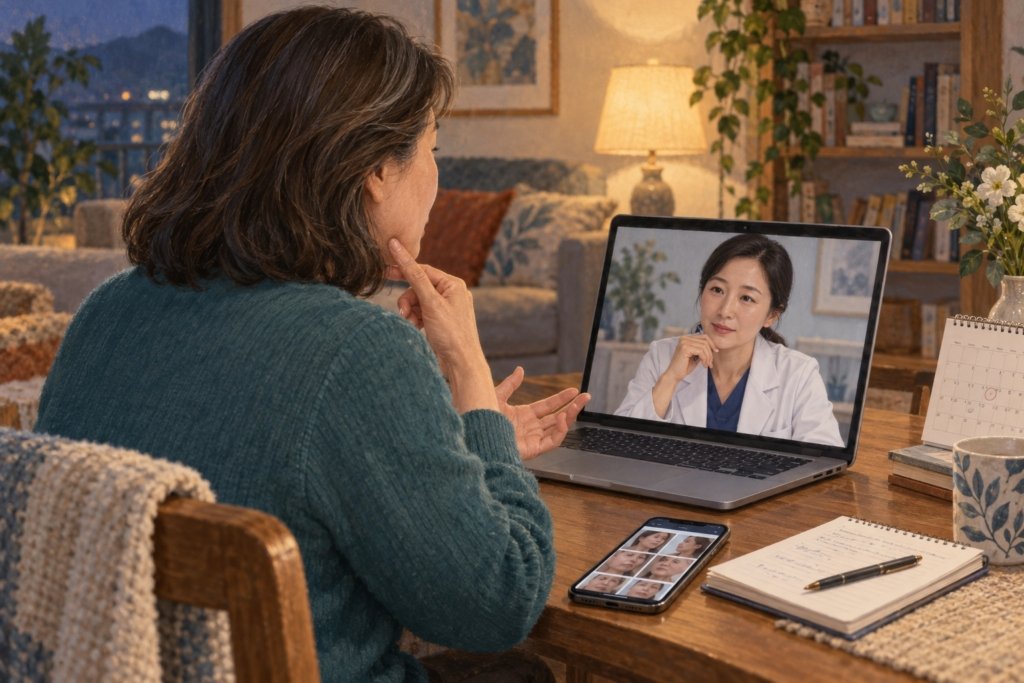
One of the biggest misconceptions about medical travel is that recovery ends when you board the flight home. It doesn’t.
Bruising may fade fairly quickly, but swelling can continue for weeks, temporary numbness can last longer, scars mature over months, and the jawline and neck keep refining gradually. That’s exactly why long-distance follow-up needs to be arranged in advance.
Ask About Follow-Up Before Surgery, Not After
Before you commit, get clear answers to:
- Who do I contact after returning home?
- Can I send photos if I’m concerned?
- Will I speak with the surgeon or only a coordinator?
- Are video consultations available?
- Which symptoms need urgent attention?
- Who should examine me locally if there’s a problem?
- How long does follow-up continue?
These questions are less exciting than talking about your future jawline, but they’re among the most important ones an international patient can ask.
What Happens If There’s a Complication?
Every operation carries risk. Facelift complications can include hematoma, infection, delayed wound healing, unfavorable scarring, asymmetry, sensory changes, skin problems, and nerve-related issues. Serious problems are uncommon in well-selected patients having well-planned surgery, but no surgeon can promise zero risk.
When surgery happens abroad, complication planning matters more, because your operating surgeon may not be physically reachable once you’re home. Ask how urgent problems are handled, know how to reach the team outside office hours, and never wait for an international flight if you develop symptoms that need immediate care.
Tell the Surgeon Your Full Medical History
Cosmetic surgery is still surgery. Don’t withhold information because you’re worried it might delay your procedure. Be open about prescription and over-the-counter medications, supplements, allergies, smoking or nicotine use, previous surgeries, bleeding problems, cardiovascular conditions, diabetes, and any past reactions to anesthesia.
Some medications and supplements affect bleeding or interact with anesthesia. Let your surgeon decide what to stop or continue. Never discontinue a prescription on your own because of something you read online.
Smoking and Nicotine
Nicotine affects blood flow and wound healing, which is especially relevant in surgery involving skin flaps. If you smoke, vape, or use any nicotine product, say so honestly. Surgeons have their own protocols for how long nicotine should be stopped before and after surgery, so follow yours. Concealing nicotine use doesn’t make surgery safer.
Flying Home After Facelift Surgery
Long flights add their own stress: hours of sitting, disrupted sleep, dehydration, and luggage handling. When you can safely fly depends on your procedure, your progress, your medical history, and your surgeon’s judgment.
Don’t pick a return date from a generic online recovery timeline. Ask your surgeon when they consider you fit to travel, and remember that being cleared to fly doesn’t mean all the swelling and bruising has resolved.
Visa Requirements for Medical Travel to Korea
Entry requirements depend on your nationality, the length of treatment, and your circumstances. Korea offers medical-visit visa categories for eligible patients, including short-term and longer-term stays, but not every facelift patient needs a dedicated medical visa. Medical Korea advises confirming requirements with the relevant Korean embassy or consulate.
Rules change. Check the current requirements for your passport before buying non-refundable travel.
Do You Need a Medical Tourism Agency?
Some patients arrange treatment directly with a clinic; others go through an agency. Neither route guarantees a better experience.
If you use an intermediary, understand its role. Is the agency registered? How is it paid? Does it receive a referral commission? Can you contact the clinic directly? Who is responsible if communication breaks down?
Convenience should never stop you from independently researching the surgeon and the institution. The surgical decision is yours.
Be Careful With Social Media Marketing
Korean plastic surgery is highly visible on social media, which makes it a useful place to discover surgeons and learn terminology. It shouldn’t be where research ends.
Follower counts don’t measure skill. A viral transformation says nothing about complication rates. A celebrity patient doesn’t tell you whether a procedure suits your anatomy, and a heavily edited photo hides scar quality.
Use social media for discovery. Use consultation and independent verification for decisions.
Revision Facelift in Korea: Extra Planning Required
If you’ve had a facelift before, your case is more complex. Previous surgery creates scar tissue and alters normal anatomical planes, which can affect dissection, tissue mobility, blood supply, incision planning, recovery, and risk.
Look specifically for a surgeon experienced in secondary facial surgery. Bring your previous operative records if you have them, describe exactly what was done, and share older photographs so the surgeon can see how your face has changed over time.
Combining a Facelift With Other Procedures
Many patients want to make the most of one trip by combining a facelift with a neck lift, upper or lower eyelid surgery, a forehead lift, fat grafting, or skin treatments.
Sometimes that makes sense. But more surgery isn’t automatically better. Longer operating time and additional surgical sites affect recovery and risk. Base the decision on medical appropriateness, not on maximizing procedures before your return flight.
What Does a “Natural” Facelift Result Actually Mean?
Almost everyone searching for Korean facelift surgery says they want a natural result. Natural doesn’t mean doing as little as possible, though. It means an improvement that fits your facial anatomy without an obviously operated look.
A successful result usually includes better jawline definition, reduced jowling, repositioned facial tissues, a smoother transition between face and neck, and, crucially, preserved facial identity. The goal is a refreshed version of you, not a different person.
Questions to Ask Before Booking a Facelift in Korea
Before paying any deposit, make sure you can answer these:
- Who will perform my operation, and what are their qualifications?
- How often do they perform facelift surgery?
- What technique will be used, and why does it suit my anatomy?
- Will my neck be treated?
- Where will the incisions be?
- What type of anesthesia will be used, and who provides it?
- How long will the operation take?
- What complications should I understand?
- How long should I stay in Korea, and how many follow-up visits are needed?
- When will sutures or staples be removed?
- When can I fly home?
- What happens if I have a problem after returning home?
- What exactly is included in the price?
- Who will communicate with me after surgery?
If you can’t get clear answers, don’t rush.
A Good Consultation Sometimes Ends With “Not Yet”
One sign of a thoughtful surgeon is that they don’t recommend surgery to everyone. You might arrive expecting a full facelift and learn that your aging is still relatively mild. You might be set on a deep plane facelift when another approach fits better. Or you might have a medical issue that should be addressed first.
A consultation isn’t a sales appointment. Its purpose is to determine whether surgery is appropriate at all and, if so, which operation makes sense. Sometimes the safest recommendation is to wait.
Facelift in Korea: The Bottom Line
Korea gives international patients access to surgeons experienced in facial aesthetic surgery and a healthcare system with established infrastructure for foreign patients. But geography doesn’t determine quality. A clinic being in Seoul doesn’t make it the right clinic. An operation being called a deep plane facelift doesn’t make it the right technique. And a lower price than at home doesn’t automatically mean good value.
A successful medical trip starts with careful research. Verify the surgeon and the clinic. Understand exactly what’s planned. Know the risks. Allow enough time for recovery. Understand what happens after you go home. And choose a procedure because it fits your anatomy, not because it’s trending.
So instead of asking, “Where can I get the best Korean facelift?”, try a better question:
“Which surgeon can clearly explain my facial aging, recommend an appropriate operation, and safely support me before, during, and after surgery?”
That shifts the focus away from packages and marketing terms and puts it where it belongs: on anatomy, surgical judgment, safety, and long-term care.
FAQ
No. The term describes where the surgery is performed, not how. Surgeons in Korea use a range of approaches, including SMAS and deep plane techniques, often combined with neck surgery or fat grafting depending on the patient.
It depends on the procedure and your recovery. Plan your stay around the surgeon’s follow-up schedule, including wound checks and suture removal, rather than around the earliest available flight.
Both address the deeper supporting layer of the face, but in different ways. A deep plane facelift releases and repositions deeper tissues as a unit, while SMAS techniques tighten, fold, or reposition the SMAS layer. The right choice depends on your anatomy, not the name.
It varies by clinic. Always request a written quote that specifies whether the surgeon’s fee, anesthesia, operating room, tests, medications, follow-up visits, neck surgery, and coordinator services are included.
No. Your surgeon should clear you for air travel based on your procedure and recovery. Being cleared to fly doesn’t mean swelling and bruising have fully resolved.
Check the Korean Society of Plastic and Reconstructive Surgeons directory and confirm the clinic is registered to treat international patients through Medical Korea.